

Last week I wrote about how to ask an archive for a book that isn’t in the catalogue. This week I want to go back to the objects, because I have two of them sitting on the desk at the same time for the first time, and putting them side by side told me something I had been getting wrong for about a year.
They are Continental Loan Office bills of exchange. Both were signed by Francis Hopkinson, Treasurer of Loans — the same Francis Hopkinson who, as I wrote in an essay a few weeks ago, billed Congress for designing the flag and asked to be paid in wine.
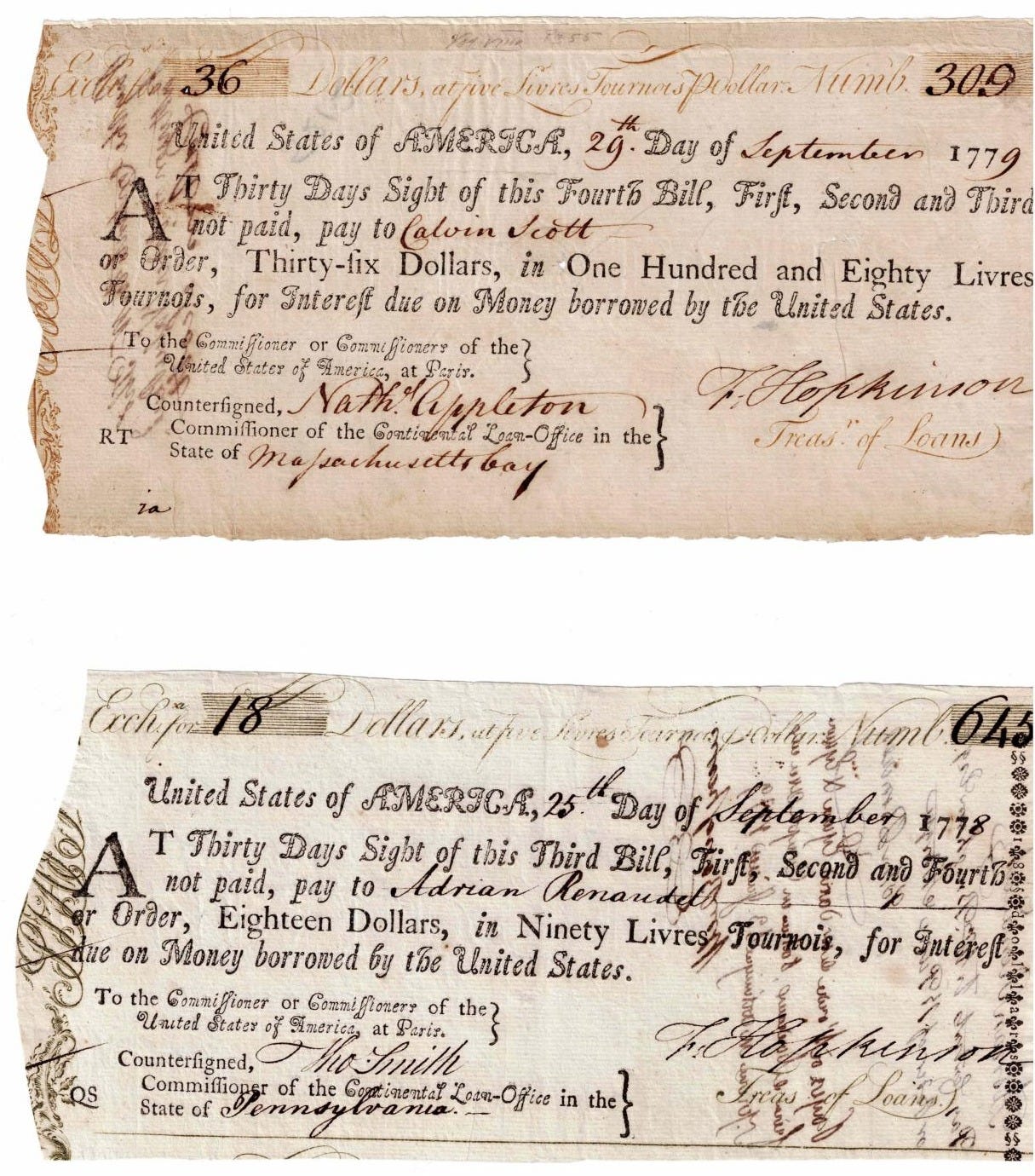
The first is dated 25 September 1778. The second is dated 29 September 1779. A year and four days apart.
And until I laid them next to each other, I had been picturing the Continental Loan Office as a room in Philadelphia.
What the two sheets share
Put them side by side and the first thing you see is that they are the same document twice.
Both are printed forms with the particulars filled in by hand. Both open with the same set phrase — “At Thirty Days Sight of this Third Bill, First, Second and Fourth not paid” on the earlier one, “of this Fourth Bill, First, Second and Third not paid” on the later. Same sentence, with the position in the sett dropped into it.
Stop on the first four words, because they matter. Thirty days sight. Neither of these is a demand for cash on the spot. Present it, and a clock starts — thirty days of somebody else’s use of the money before you see any of it.
Both are addressed the same way: “To the Commissioner or Commissioners of the United States of America, at Paris.”
Both state the same reason for existing: “for Interest due on Money borrowed by the United States.”
And both carry the same signature at the foot — F. Hopkinson, Treas’r of Loans.
Read that list again, because it is stranger than it looks. These are interest payments. Somebody in America had lent money to Congress, and this is the coupon. And the coupon is payable in Paris.
The part I had not taken in
An American lends money to the United States. The United States owes him interest. So the United States hands him a piece of paper that he cannot cash in America at all — he has to get it across three thousand miles of wartime ocean to a commissioner in Paris, who will pay him in French money.
Both bills state the sum twice, once in each currency. The 1778 bill is for eighteen dollars, in ninety livres tournois. The 1779 bill is for thirty-six dollars, in one hundred and eighty livres tournois. Five livres to the dollar, both times, a year apart.
I had read that sentence on the first bill a dozen times without hearing it. It was only when the second one said exactly the same thing in exactly the same words that the arrangement came into focus. The domestic debt of the United States was serviced abroad. Congress could not pay its own lenders in its own country, in its own currency, and so it wrote them orders on a French account and left them to solve the Atlantic themselves.
A brief note before I go on: I publish these primary-source essays on early-Republic financial history, and they’re free. If this is your sort of thing, a subscription puts each one in your inbox as it comes out.
And then the difference
Everything above is the same on both sheets. Here is what is not.
Underneath Hopkinson’s signature, each bill carries a second one — a countersignature, from the official who actually issued it.
On the 1778 bill it reads: “Countersigned, Tho. Smith, Commissioner of the Continental Loan-Office in the State of Pennsylvania.”
On the 1779 bill: “Nath. Appleton, Commissioner of the Continental Loan-Office in the State of Massachusetts Bay.”
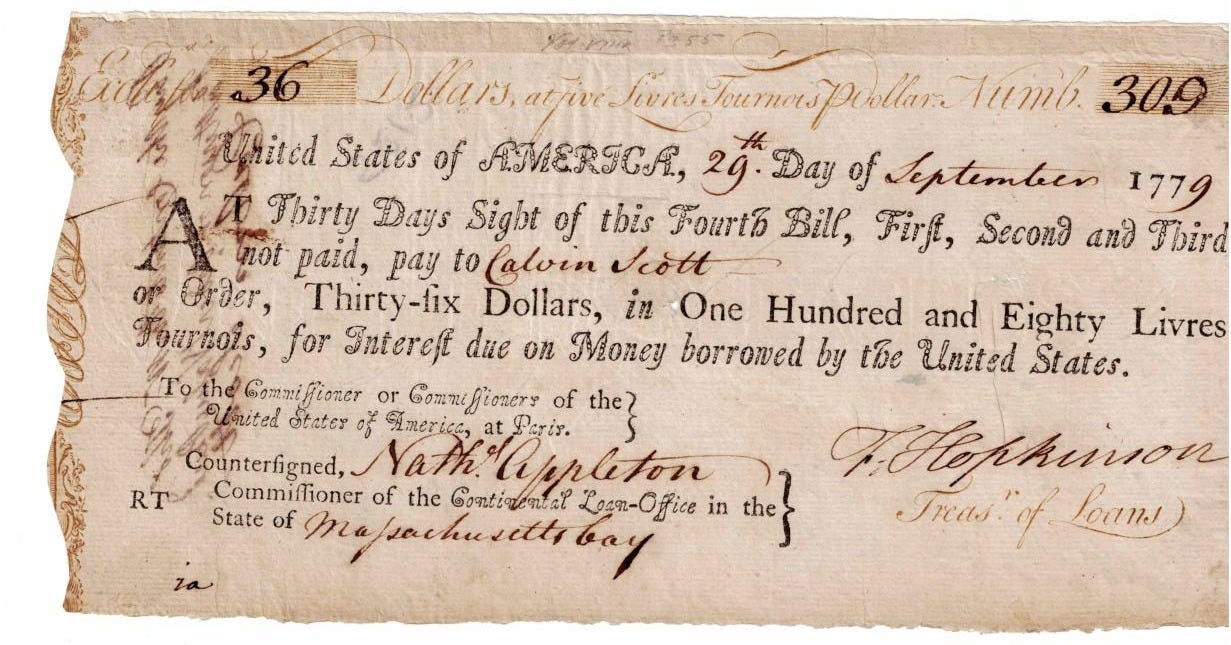
Same printed phrase. Different state written into it.
That is the whole discovery, and I am slightly embarrassed by how long it took. The printed form says “the State of ——” because the form was designed to be used in any of them. There was not a Continental Loan Office. There was one in each state, each with its own commissioner, each issuing the same paper, all of it signed by the same Treasurer of Loans and all of it drawn on the same account in Paris.
I had been reading “the Continental Loan Office” as a place. It is a system.
What that changes about the paper in front of me
It changes what these two objects are to each other.
I had been thinking of the second bill as a duplicate — a second example of a thing I already had. It isn’t. It is the same institution, observed from a different state, a year later. One sheet on its own tells you what a Continental Loan Office bill looked like. Two sheets from two states tell you that the form was standardised, the rate was stable at five to one across a year, the language did not drift, and the Treasurer’s signature was the thread that tied thirteen separate offices into one debt.
That is a different kind of evidence. A single document is an instance. Two documents from two states, a year apart, are a system with a tolerance.
The two commissioners
I want to be honest about the limits of what I can tell you here.
Thomas Smith in Pennsylvania and Nathaniel Appleton in Massachusetts are now, as far as I am concerned, the next two names on the list. I know what their titles were, because the bills print them. I know they were doing the same job, a year apart, in two offices about three hundred and fifty miles apart along the colonial post road — which in those years meant ten days to a fortnight on horseback, one way. Beyond that I have very little, and I am not going to invent any.
They were the point where a national obligation touched an actual person. Congress voted the loans. Hopkinson signed the bills. But it was Smith, or Appleton, or one of their counterparts in the other states, who sat in a state office, wrote the name of his own state into the blank on the form, and handed the paper across a desk to the man who had lent the money.
Appleton is the one I want to go after first, partly because Massachusetts records of that era are unusually good, and partly because I have just been given a reason to write to Boston about something else entirely.
Sit with those two names for a second, because I think the distance between them explains the blank.
You cannot run a thirteen-office system by correspondence when a question takes a fortnight to ask and a fortnight to answer. Smith could not write to Philadelphia for a ruling and wait a month. Appleton, further out still, could not either. Whatever arrived at his desk had to be usable on its own, without instruction, by a man who might be the only person in the state who understood it.
So the system was not coordinated. It was standardised. The same printed form, the same printed sentence, the same printed drawee in Paris — and one blank, left for the only fact that differed. The blank is not sloppiness. It is the design. It is what you do instead of asking.
The bookkeeper says so
While the two sheets were on my desk, a scan arrived from Philadelphia — a letter Hopkinson wrote from his own office on 11 December 1778, about eleven weeks after signing the earlier of the two bills. He is writing to the Commissioners at Paris — Franklin, Adams, and Lee — to tell them what he has just put into circulation.
He organises what he has issued by state.
“To the State of Pennsylvania,” he writes, and lists three ranges of numbered bills at three denominations. “To the State of New Jersey,” he writes, and lists two more. His own word for the bills is “Sets” — the same word the printed forms imply with their First, Second, Third and Fourth — and he counts them a hundred at a time.
I had inferred the distributed system from the blank on the form. Hopkinson organises his own bookkeeping in exactly the categories that would produce that blank. The state header at the top of his letter is the same blank on my bill, opened at the top of the page instead of written into it at the bottom.
He posted the letter in four copies. Original, Duplicate, Triplicate, Quadruplicate — four sheets of the same content, sent by four ships, so that at least one would arrive across a wartime Atlantic. He marks each copy so the Commissioners will know which is which when they arrive weeks or months apart.
Four copies of a letter, and four bills to a set. It was the same fear both times.
The edge
There is one more piece of that design, and I only saw it because I had both sheets out at once.
Three sides of each bill are ordinary — plain margins, and a printed ornamental border down the right. The left edge is not ordinary.
It runs in a series of curves, and they are not torn curves. Somebody cut along a deliberate scalloped line. I assumed at first that the two would match, that there was a standard die at the printer’s.
They don’t match. One has two broad humps; the other has four or five tighter ones. Two sheets, two states, a year apart, cut along two different waves.
The left edge is where a binding would sit, which is what made me reach for the obvious comparison — a cheque torn out of a chequebook, except that instead of a straight perforation somebody cut a curve.
So I went looking for the evidence that would prove it. Needle holes along the edge. Paste residue. The discoloured strip you get where a stub has been attached for two hundred years.
There is none of that on either sheet.
That doesn’t kill the idea, because if a bill was cut away from a stub then the holes stayed with the stub. But it does mean I can’t show it, and I would rather report the gap than fill it. So I will say only what the paper says: each of these was cut, deliberately, along a line that was never used again — and whatever it was cut away from is not here.
What it is, though, has a name. It is an indent, and it is where the word indenture comes from. You divide a document along an irregular line, and from then on the only way to prove the piece in your hand is the real one is to lay it against the piece it was cut from. The curve is the proof. No two cuts are alike, and a forger cannot guess a curve.
And then there are the lines
Just inside that cut edge, on both bills, there are two short slanted strokes that run off the page. They begin nowhere and they end at the edge.
They begin nowhere because their other halves are somewhere else.
That is the rest of the indent, and it may be the better part of it. A wavy cut is a shape, and a shape can be traced by anybody who gets hold of the counterpart. Two pen strokes drawn across a join before the join was cut are a harder problem: to fake them you would have to match the position, the angle, the width, the ink and the hand — and then make your curve arrive at precisely the right place to receive them.
I don’t know for certain why they did it this way. But I think I know what it defends against, and it isn’t a man with a pen.
In 1777 the British were counterfeiting Continental paper on matched stock, well enough that it was advertised openly in a New York newspaper. I wrote about that earlier this summer. Against a press that good, a printed form is not a defence at all. They can print too. They can print better.
What a press cannot do is cut a sheet away from a particular counterpart. A stolen blank, filled in correctly and signed convincingly, is still a sheet that was never joined to anything. Its curve fits nowhere. Its strokes complete nothing.
The security was never in the printing. It was in the fact that this piece of paper used to be joined to another piece of paper — and there is only one other piece of paper in the world it can be joined back to.
So add it up. A bill leaving a state loan office in 1778 carried a printed form, a serial number, an interest sum written out twice, the Treasurer’s signature, the commissioner’s countersignature, a cut that fits in one place, and two strokes of ink that finish somewhere else.
A man three hundred and fifty miles away could not be consulted, and a clerk three thousand miles beyond him certainly could not. So the document was built to answer every question anybody might ask of it, without anybody having to ask.
The backs
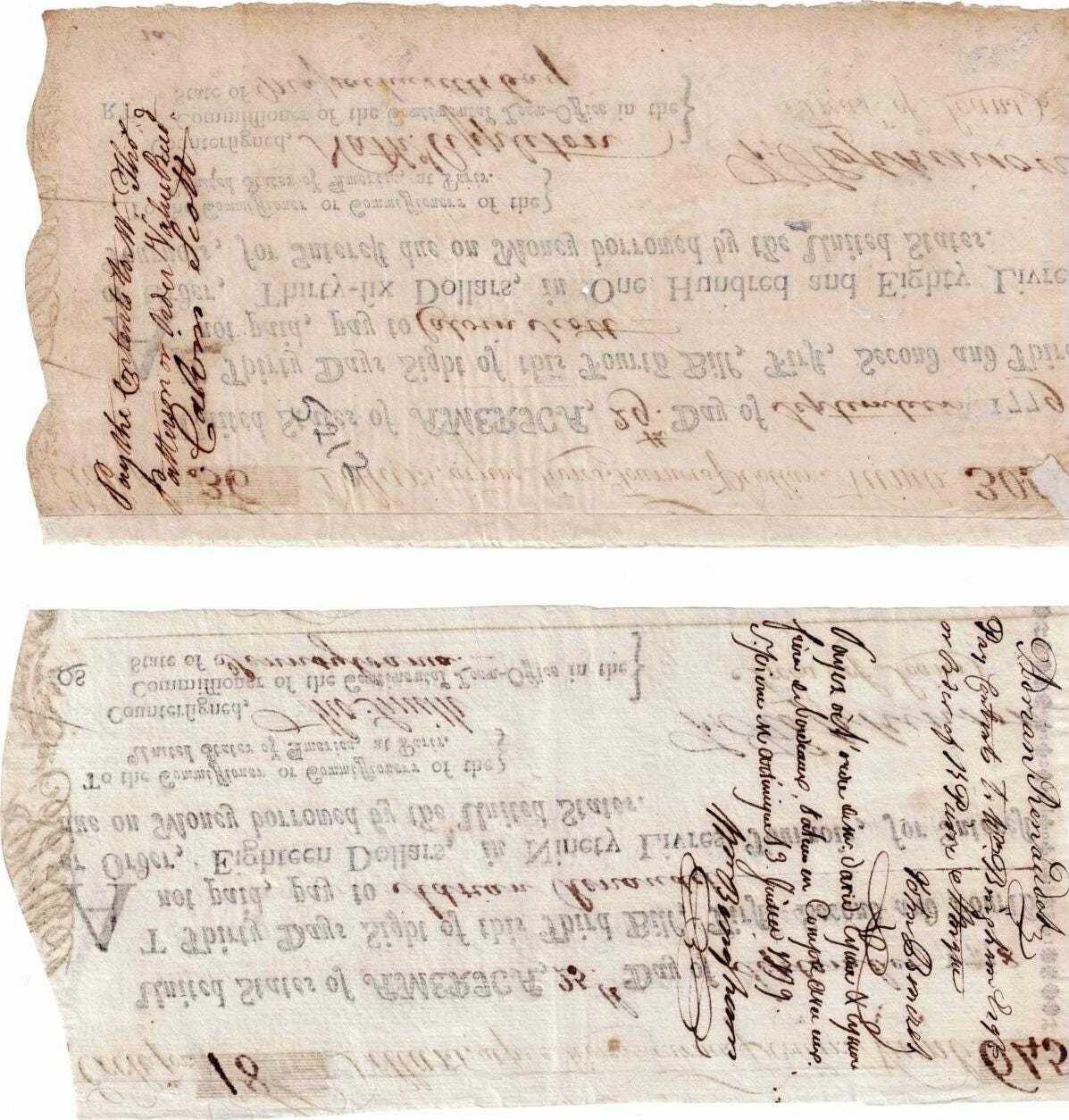
Both bills are endorsed on the reverse, and the backs are where these things stop being forms and start being transactions.
The 1778 bill leaves its original payee, passes through a Philadelphia merchant who directs it to William Bingham — Congress’s commercial agent at St. Pierre, Martinique — and goes on from there, with a French endorsement written at Martinique in July 1779, to a merchant house at Bordeaux. I wrote about that chain in an essay this summer, and it remains the single most satisfying thing I have found on a piece of paper I own.
The 1779 bill has a chain of its own. It begins with the man it was made out to, a Calvin Scott, passes to a second endorser whose surname I have not managed to read, and continues. I am not going to guess at a name I cannot read; that is exactly the mistake I spent a year making with a different name on a different bill, and I would rather report the gap than fill it.
But the shape is already legible. Two bills, two states, and in both cases the same thing happens on the back: the instrument does not go to Paris in the hands of the man who earned the interest. It gets endorsed away, almost immediately, to somebody better placed to collect it. A lender in Pennsylvania or Massachusetts had no practical way to present a bill in Paris. A merchant with Atlantic correspondents did.
Which means the lender, in both cases, took something less than the face of the bill and let somebody else carry the ocean. I don’t know what either of them settled for. But whatever Congress thought it was paying in interest, that is not what arrived.
What I think I have
Not a rare object. Loan Office bills survive in reasonable numbers, and anyone who wants one can find one.
What I have is two of them that answer each other. Same form, same Treasurer, same Paris account, different state, different commissioner, different year, and two different endorsement chains showing the same behaviour. That is a comparison, and a comparison is worth more than either sheet alone.
I spent a year treating the first bill as a rare survival and the second as a spare. They were never the interesting thing separately. The interesting thing was always the gap between them, and I had to put them on the same desk to see it.
Coming up: a man named Simon Gratz, and what he did to nineteenth-century manuscript collections that researchers are still working around today. Thanks for reading.
— Paul
Yes — and I've been trying to work out which third bill would teach the most.
Two things one would settle.
The first is the rate. Both of mine convert at five livres to the dollar, a year apart — and that was a year in which the paper dollar was falling hard. If a 1780 or 1781 bill still reads five to one, then the interest on these loans was insulated from the collapse in a way almost nothing else was. If the ratio moved, that tells you something too. Either way it's a real answer, and it's sitting on the face of any third bill.
The second is the cut. Both of mine have a hand-cut wavy left edge, and the two waves don't match each other. A third would tell me whether every bill got its own curve — which is what I think — or whether I just happen to have two from different batches.
And honestly, two is thin. Two documents can agree by accident. Three is when you start to be entitled to say "always."
The encouraging part is that these aren't rare. A third is a matter of watching the right catalogues, not of getting into an archive.
If you get more of these bills and compare them, do you think you'll learn even more?