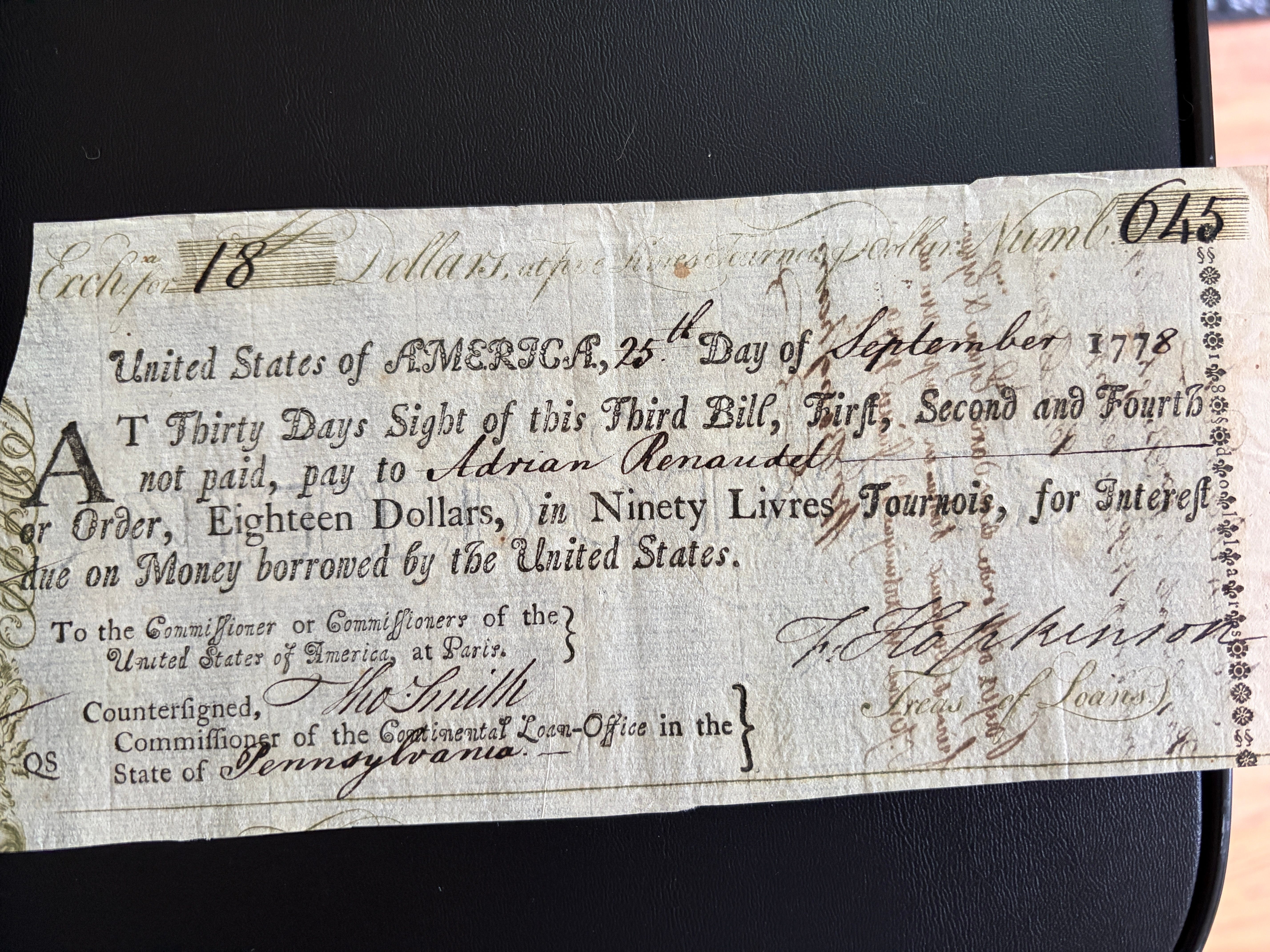
I have owned the bill of exchange for a long time. I have written about it publicly. I have researched it for months. I have inquired at the National Archives about its underlying loan certificate. I have declared, in a Substack essay one week ago, that the story of Adrian Renaudel was probably lost to history.
Then I photographed the back of it for the first time.
Everything I said last week is partly wrong. The archives had an answer. It was written on the reverse of my own document, in my own possession, and I had never taken the time to look.
This is the latest piece in a running project I’m publishing on the primary-source financial history of the American founding period. The essay it corrects was last week’s — In Search of Adrian Renaudel — the story of a 1778 Continental Loan Office bill of exchange, signed by Francis Hopkinson as Treasurer of Loans, made out to a French national whose story I said had been lost.
Reader, I was wrong.
The front of the bill is what I described last week: a small piece of printed copperplate, filled out in Philadelphia on 25 September 1778, ordering payment of eighteen dollars — ninety livres tournois — to Adrian Renaudel or order, drawn on Benjamin Franklin at the American Commissioners’ residence at Passy. Signed by Hopkinson. Countersigned by Thomas Smith of the Pennsylvania Loan Office. Payable in Paris.
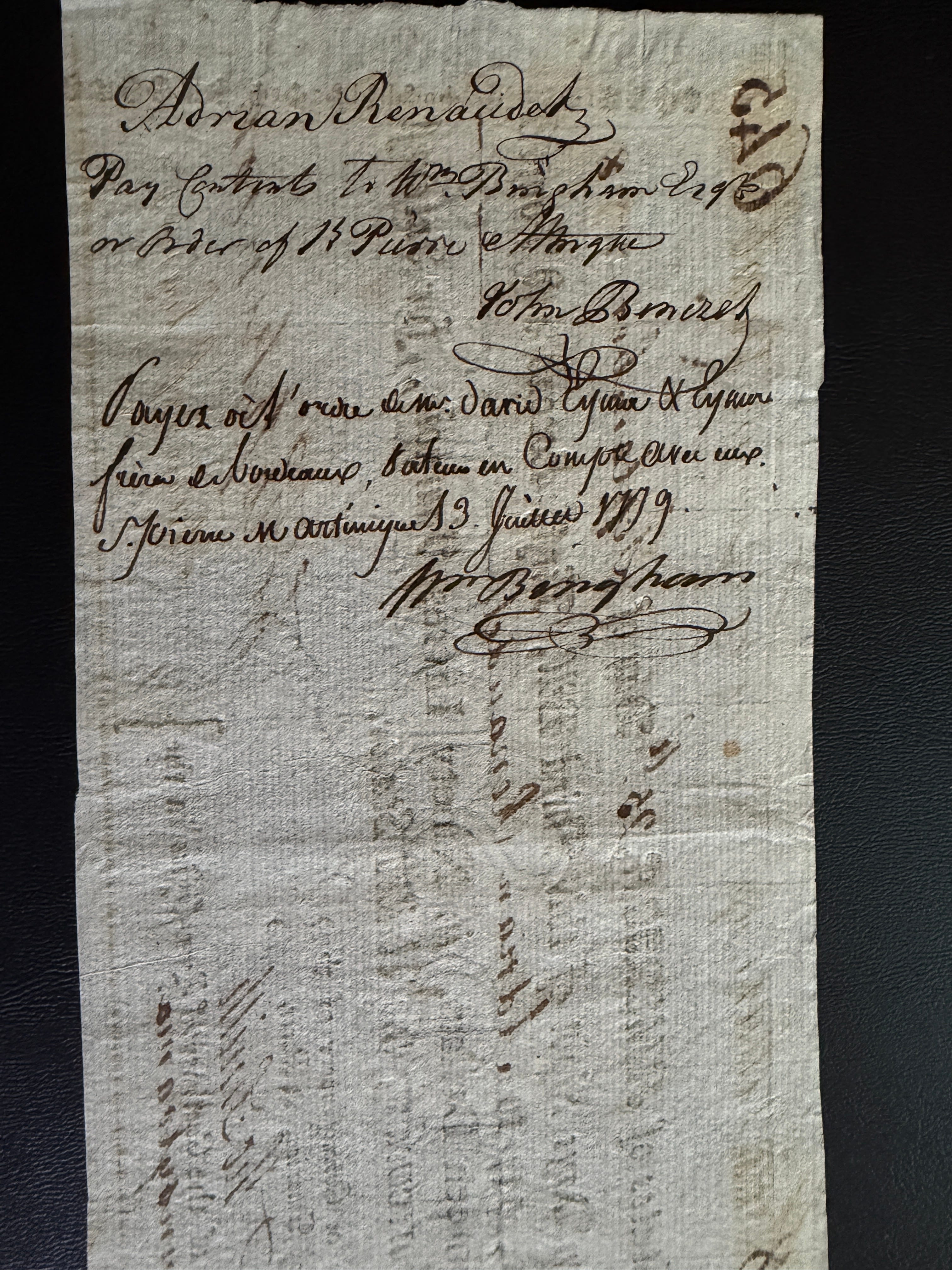
The back of the bill is where the story I told last week starts to come apart.
The reverse carries two endorsements in period ink, in two different hands, in two different languages. The upper endorsement is in English, and it is in Adrian Renaudel’s own hand. He signs his name across the top of the paper — Adrian Renaudel — in a firm, slightly right-slanted secretary hand, the “d” clearly formed, the “R” of Renaudel looping with confidence. Below his signature he writes an instruction:
Pay Contents to Wm. Bingham Esqe. or Order of St. Pierre Martinique.
The signature that follows, in a different hand, appears to read John Benezet — likely a witness or co-endorser, and possibly a relative of Anthony Benezet, the Philadelphia Quaker abolitionist. That connection I want to sit with a moment before continuing, because it opens a research thread I did not have last week.
The second endorsement, below the first, is in French. It is dated at St. Pierre, Martinique, on the 13th of July 1779. It reads, in the confident hand of a man who had been running Continental Congress business in the French Caribbean for three years:
Payez à l’ordre de Mr. David Cypian & Cypian frères à Bordeaux, valeur en compte avec eux. St. Pierre Martinique, 13 juillet 1779.
Which translates to: Pay to the order of Messrs. David Cypian and brothers of Bordeaux, value in account with them.
Below that instruction, in a large and slightly hurried signature, is the name I did not expect to find on my document:
Wm. Bingham.
(Before I go further: I publish these primary-source essays on early-Republic financial history weekly. Last week’s piece is the one this essay corrects; the two together form a small worked example of what it looks like to keep discovering things about an object you already own. A free subscription is the easiest way to follow the project — and to catch corrections when they come.)
William Bingham. He was twenty-six years old in July 1779, and he had been in Martinique for three years, serving as the official Continental Congress Agent at St. Pierre. Bingham had been sent to the French Caribbean in 1776, at the beginning of the Revolutionary War, with a specific mandate: procure French munitions and supplies for the Continental Army, arrange American privateer operations against British Caribbean shipping, and handle the intricate financial mechanics required to keep an army in the field paid for through a Caribbean intermediary. He was Congress’s man in the French islands. Every American ship that put into Martinique for supplies passed through his office. Every Continental bill of exchange that reached the Caribbean crossed his desk.
He was also, at twenty-six, a man who was starting to become extraordinarily rich.
By the end of the Revolution Bingham was one of the wealthiest men in America. He returned to Philadelphia, joined Robert Morris in founding the Bank of North America — the young republic’s first commercial bank — and later served as United States Senator from Pennsylvania (1795–1801), where he was a leading Federalist. His daughter married Alexander Baring, whose family founded Barings Bank in London. He is the reason there is a town in New York called Binghamton. His papers, most of them, are held at the Historical Society of Pennsylvania.
And in July 1779, at St. Pierre, Martinique, William Bingham took Adrian Renaudel’s Continental Loan Office bill of exchange, endorsed it to a Bordeaux merchant house called Cypian frères, and put it into the transatlantic circuit that would carry it toward its eventual redemption at Franklin’s Passy residence in Paris.
What I said last week was that the archives could not find Adrian Renaudel. That was true of the National Archives at College Park, which does not name-index the Register of Pennsylvania Loan Certificates. But it was not true of the object I own. The object told me who Renaudel had been transacting with. It named William Bingham as his agent. It named Cypian frères as the Bordeaux firm through which the bill would be redeemed. It placed Renaudel geographically and commercially inside the transatlantic merchant network that connected Philadelphia, St. Pierre, and Bordeaux in 1779.
Renaudel was not an obscure French national of whom nothing survives. He was operating within the specific circuit of the American Congressional Agent at Martinique. If William Bingham was willing to endorse a Continental bill of exchange in Renaudel’s favor and route it through his own commercial network to a Bordeaux firm — with the phrase “valeur en compte avec eux,” value in account with them, meaning Cypian frères was to credit Bingham’s account for the amount — then Renaudel had a working relationship with Bingham. Which means Renaudel almost certainly appears somewhere in Bingham’s correspondence. Which means his identity is probably still recoverable.
Bingham’s papers at HSP would be the first place to look. The Cypian frères business records — if they survive in the Bordeaux municipal archives, and firms of that size usually do — would be the second. The colonial records of St. Pierre, Martinique for 1778-1779 would be the third. A French national named Adrian Renaudel operating between Martinique, Bordeaux, and Philadelphia in the middle of the Revolutionary War is not the sort of person the historical record loses cleanly.
I had been looking in the wrong archive. The right archive was the back of the object I already owned.
There is something instructive in this that I want to sit with for a moment, because it is what has actually stayed with me since I turned the bill over yesterday afternoon.
Primary-source historical work is a discipline built around a particular kind of humility. The document you own knows things you do not know. You can hold it in your hands for thirty years — I have owned this bill nearly that long — and remain profoundly ignorant of what it is telling you. The archives you consult are external to the object. The object itself is an archive.
When I wrote In Search of Adrian Renaudel last week, I framed the essay around the National Archives’ inability to find Renaudel’s underlying loan certificate. I treated the archival gap as the essay’s actual argument. I closed the piece on the philosophical claim that individual foreign lenders’ stories have been lost, one bet at a time, and that this obscurity was itself a feature of how the founding worked.
The philosophical claim is still true at the aggregate level. There were tens of thousands of loan certificates issued, and the vast majority of individual lenders are irrecoverable. But it was the wrong essay to write about Adrian Renaudel. Renaudel is one of the recoverable ones. He is not lost. He is written on the back of the paper I have kept in a folder for years, and I had never bothered to look.
The next essay in this series will report on what a search of William Bingham’s papers at HSP turns up on Renaudel’s name. That search is now something I actually intend to do. Whether it produces a full biography or just a single letter mentioning him — either result would be a substantial expansion of what I currently know. Either result would begin the story I said last week could not be told.
There is a phrase I remember from a graduate seminar many years ago about historical research, which I have never had cause to use in earnest until now. A professor said: “The document keeps talking. You just have to keep asking.”
I did not ask the back of my document what it thought. I had never turned it over. Last week I claimed the archive had been silent. It had not been silent. I had been.
The bill is on my desk. Both sides, now.
Turn it over.
— Paul
Next week: whatever comes back from the William Bingham papers at HSP, and the beginning of what may be a longer identity-recovery arc for Adrian Renaudel than I thought possible seven days ago.
Thank you for reading
.