

I want to tell you about an email I received on a Monday morning in late February 2026.
It came from Ashley Cataldo, a manuscripts librarian at the American Antiquarian Society in Worcester, Massachusetts. I had written to the AAS a few weeks earlier asking whether Volume 6 of the Sayward diary collection — the volume covering 1765, the year of my document — might contain any entries corroborating the transaction I owned. The AAS holds all forty volumes of Jonathan Sayward’s personal diaries, and I knew the 1765 volume was the one I needed.
Ashley wrote that she was sending along photographs of the August 1765 diary pages. Because the document was headed toward auction, she said, she would refrain from doing a signature comparison herself. But she hoped the images would help.
I opened the attachments.
I was not prepared for what I saw.
What the Diary Is
Before I describe what was on those pages, let me explain what the Sayward diary is and why it matters.
Jonathan Sayward kept a diary for nearly forty years — from 1760 until 1799, when he was eighty-six years old. He wrote in almanacs: the printed calendar pages of the year’s almanac served as the diary’s structure, with Sayward filling in the blank spaces around the almanac’s text with his own daily entries. The pages are small. The handwriting is dense. The entries are brief by necessity — there simply wasn’t room to elaborate.
What Sayward chose to record in that cramped space is, in hindsight, a remarkable window into colonial New England life. He noted commercial transactions: ships arriving from Halifax, consignments dispatched, accounts settled. He noted weather and news. He noted, with the same spare precision he brought to everything, the events of the wider world as they reached York, Maine.
He was a meticulous man. And in August 1765, the wider world was arriving in York with unusual force.
August 15, 1765
The first entry that stopped me was dated August 15, 1765 — twelve days before the date of my document.
In Sayward’s hand, in the cramped space of an almanac page: Capt Halek came home in Simpson [passenger] from Hallifax he brought me £990 at[?] the [cash?] and a duplicate... to mr Hancock for 195 Hallifax Currency.
Read that again.
Twelve days before the document in my frame was drawn, Jonathan Sayward recorded receiving money from Halifax — and noted that a duplicate transaction went to mr Hancock for 195 Halifax Currency.
The commercial relationship that Hancock’s endorsement on the back of my document implies wasn’t a one-off transaction. It was an ongoing operation. Halifax trade moving through Hancock. Sayward and Hancock working the same commercial circuit in the same month. The document dated August 27 fits into a pattern visible in the diary from August 15.
After I removed the document from its frame and read the full face for the first time, this entry gained even more force. The document itself is explicitly a Halifax instrument — drawn on August 27 in Halifax, Nova Scotia, not in London as I had originally assumed. John Freame signed it there, directing a London firm to pay Sayward. The Halifax trade Sayward recorded in his diary on August 15 is the same Halifax circuit this document inhabits. The diary and the document are not merely connected by date. They are connected by geography.
I had suspected, from the research, that Hancock was Sayward’s Boston factor — the intermediary who arranged his Halifax consignments and took a commission. The diary entry twelve days before my document was drawn confirms it in Sayward’s own hand.
That was remarkable. And then I looked at the entry for August 26.
August 26, 1765
This is the entry I was not prepared for.
the mob Rose in Boston and Destroys Governour [Hutchinson’s] House & furniture and Strip his house of every thing. they took from him in Cash £900 Sterling.
The mob rose in Boston.
On the night of August 26, 1765, a crowd estimated at several hundred people descended on the home of Thomas Hutchinson — the Lieutenant Governor of Massachusetts, the most prominent royal official in the colony — and destroyed it. They tore the building apart. They smashed the furniture. They emptied the wine cellar. They scattered Hutchinson’s papers across the street — papers that included his history of Massachusetts, years in the making. They took £900 in cash.
Hutchinson himself escaped through a back door in his nightclothes.
This was not a protest. It was one of the most violent acts of the entire pre-Revolutionary period. Even many colonists who opposed the Stamp Act were horrified. John Adams wrote in his diary that it was “an atrocious violation of the peace.” Samuel Adams publicly condemned it, though historians have long debated how clean his hands actually were.
Thomas Hutchinson — the man whose house was destroyed — was personally known to Jonathan Sayward. The American Antiquarian Society’s own finding aid for the Sayward papers lists Hutchinson alongside John Hancock as one of the “notable public men” Sayward “corresponded with and entertained.” Hutchinson was not an abstraction to Sayward. He was an acquaintance. Someone who had sat at his table.
Sayward recorded the destruction of that man’s house in his diary on the night it happened, or the morning after.
August 27, 1765
And then — the next day — John Freame, writing in Halifax, drew up document number 106.
The bill of exchange for £41.8 Sterling, payable to Jonathan Sayward of York, Maine. The third copy in its set, directed to John Biggin and Anthony Bacon in London. Endorsed on the back by John Hancock.
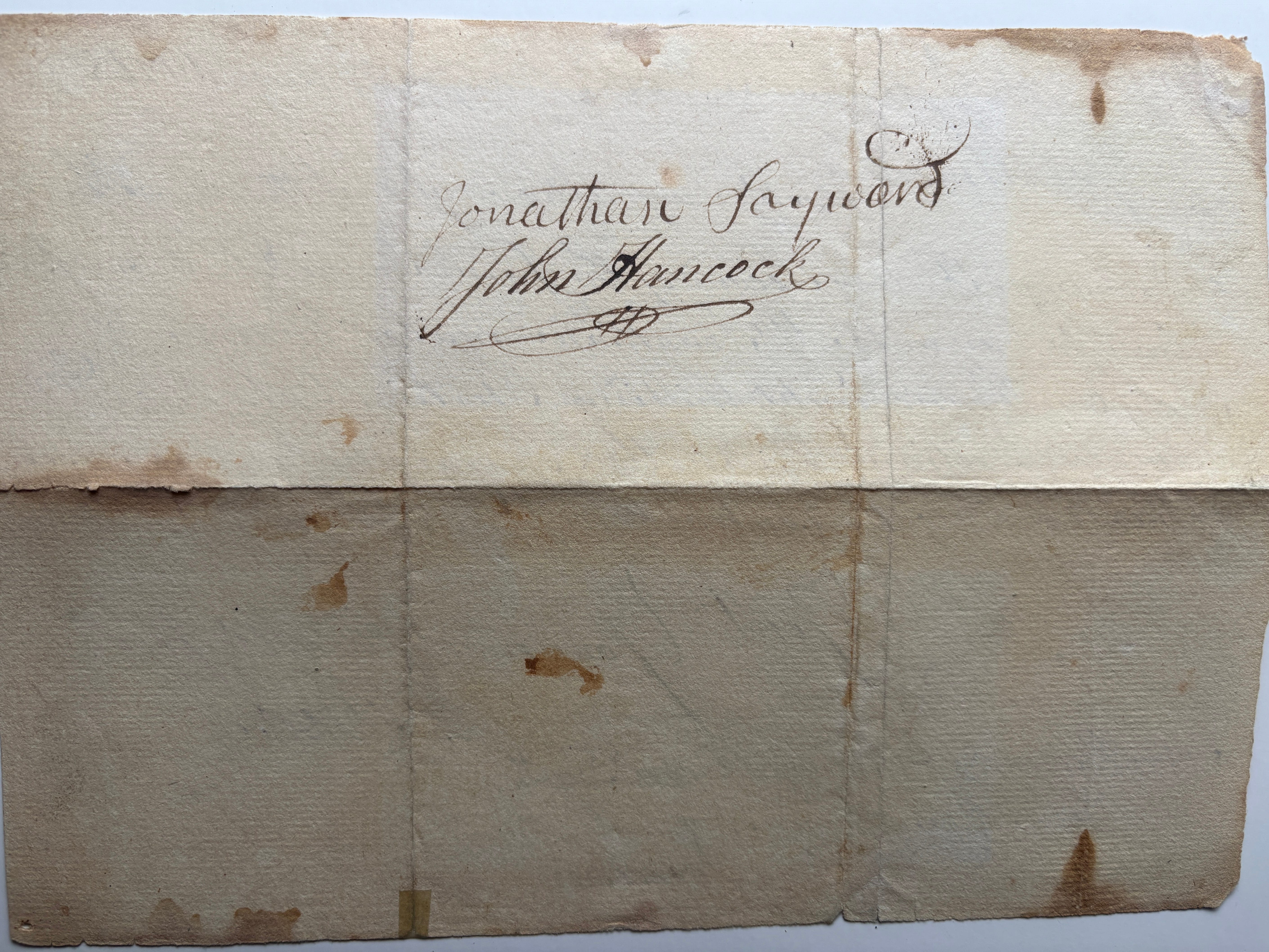
The document in my frame.
I want to be precise about the timing, because the precision is the point. Freame was in Halifax when he drew this instrument — three thousand miles from Boston, and news of the riot would not have reached him yet. To Freame, August 27 was a routine day of business. Document 106 was a settlement, one transaction among many in the Halifax-London commercial circuit.
But for the purposes of history — for the purposes of what this document means — the date August 27, 1765 is not arbitrary. It is the morning after the destruction of Hutchinson’s house. It is the morning after the most violent single act of the Stamp Act crisis. It is the document drawn the day the pre-Revolutionary period stopped being theoretical and became physical.
Jonathan Sayward was writing about the mob in his diary in York. John Freame was drawing a payment order in Halifax. The same world, three days’ sail apart, on the same morning.
The Triangle
I have been thinking about how to describe what Ashley’s email did to this research, and the best word I can find is triangulation.
I had a document. The document had a date. The date had a context — the Stamp Act, the colonial crisis, the coming Revolution.
But context is general. Context can be applied to anything dated 1765. What Ashley’s diary images gave me was something specific: two entries, written in Sayward’s own hand, on the pages immediately surrounding the date of my document. One placed Hancock in active Halifax commerce with Sayward twelve days before. One recorded a political earthquake the day before.
After I unframed the document, the triangle became tighter still. The Halifax origin confirmed by the document face connects directly to the Halifax trade entries in the diary. These are not parallel sources that happen to share a date. They are the same commercial circuit, documented from two sides — the merchant’s diary in York and the banker’s instrument in Halifax — and they now speak to each other in specific, verifiable terms.
This is not a collector’s curiosity. This is a window.
What Happened When I Removed It From the Frame
There is one more part of this story that belongs here, because it happened after I wrote the first draft of this post.
The James Spence Authentication letter of authenticity came back in early March 2026 — nine days after I dropped the document off, faster than I expected. It certified John Hancock and Jonathan Sayward. But it listed only two signatures. The mat had hidden the Freame signature entirely during the examination.
I had a professional remove the document from its frame. The mat came off. For the first time in at least twenty-eight years — possibly much longer — the full face of the document was visible.
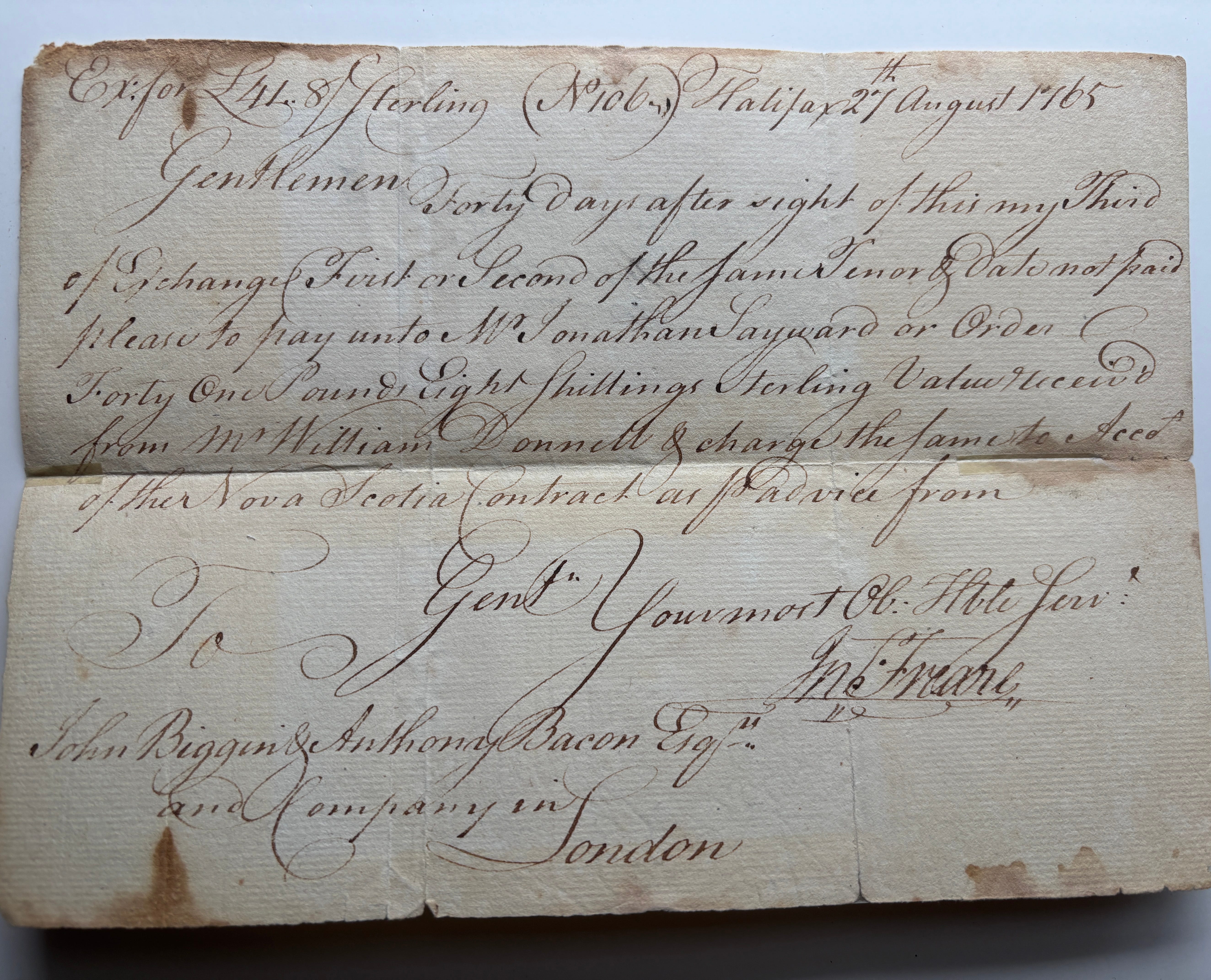
The header above the body text reads Halifax 27th August 1765 — which is how I learned that the document was not a London instrument at all, but a Halifax one. The paying agents in London are named: John Biggin and Anthony Bacon. The value was received from William Donnell. The instrument is explicitly the Third of Exchange.
And then there is the signature.
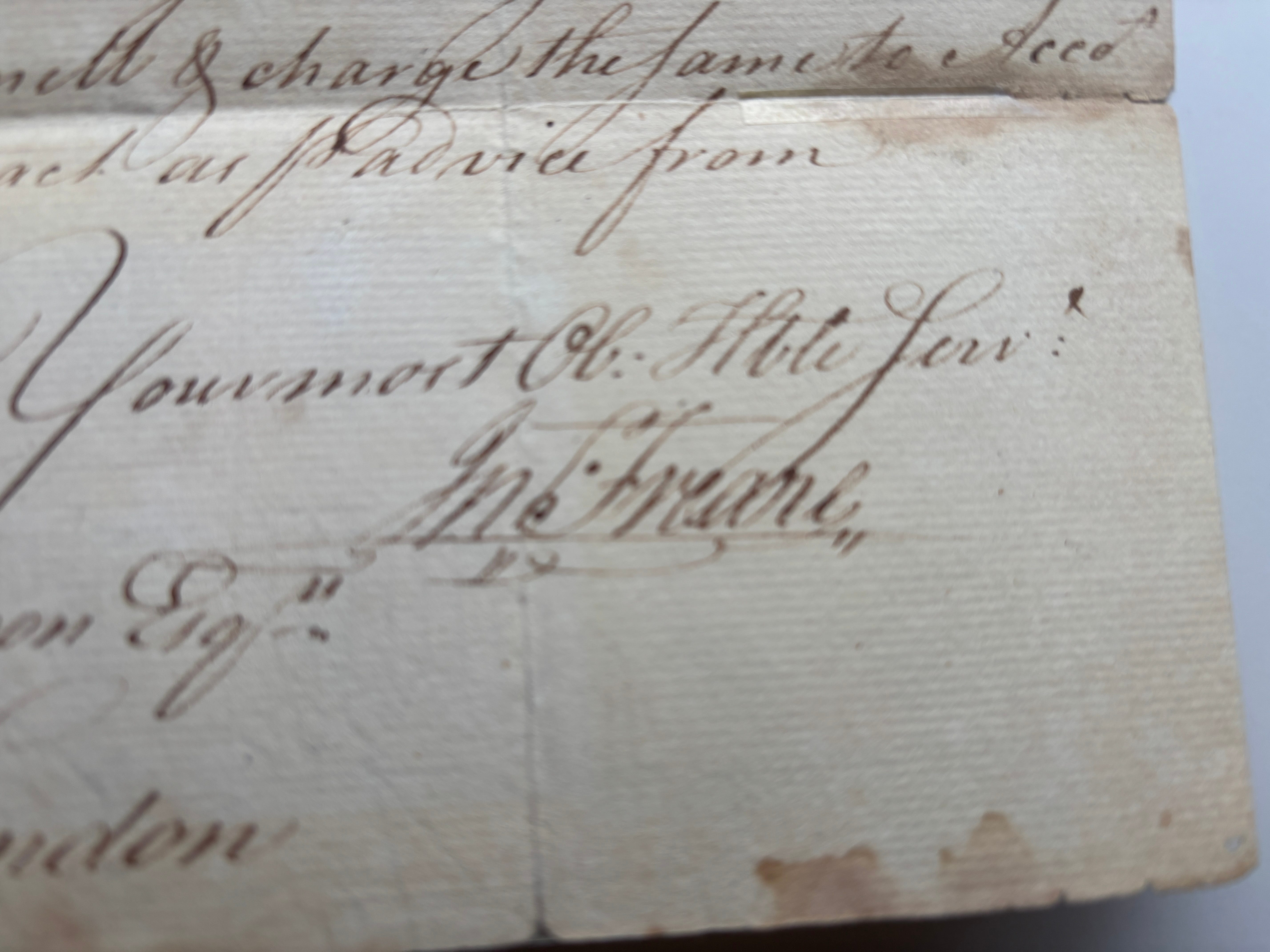
Jno Freame. Your most Obedient Humble Servant. Written in Halifax, Nova Scotia, on August 27, 1765.
Twenty-eight years. I had been looking at the top half of the document.
The third signature goes back to JSA tomorrow.
What I Wrote Back to Ashley
I replied to her the same morning her email arrived.
I told her what I had seen. I told her that the August 26 entry had transformed the paper I was writing — that the document was no longer merely dated to the year of the Stamp Act but to its most violent week. I told her that both entries would be cited prominently in the academic paper, with full attribution to the AAS collection, and that I intended to thank her by name in the acknowledgments.
I also asked if she could help me verify two other diary passages I needed for the paper — a passage from 1768, during the rescinder controversy, and an entry from December 31, 1775. Those requests are still pending.
I am waiting to hear back.
But the August entries — the mob, the morning after, the Halifax commerce moving through Hancock twelve days before — those are in the paper. They are in the abstract. They will, I hope, be in the journal.
Post 4: “What It’s Worth, and What That Means” — the authentication process, the 250th anniversary, and the question of what you do with something like this.
Paul G. Molé is a retired database administrator and independent scholar from Stillwater, New Jersey.