

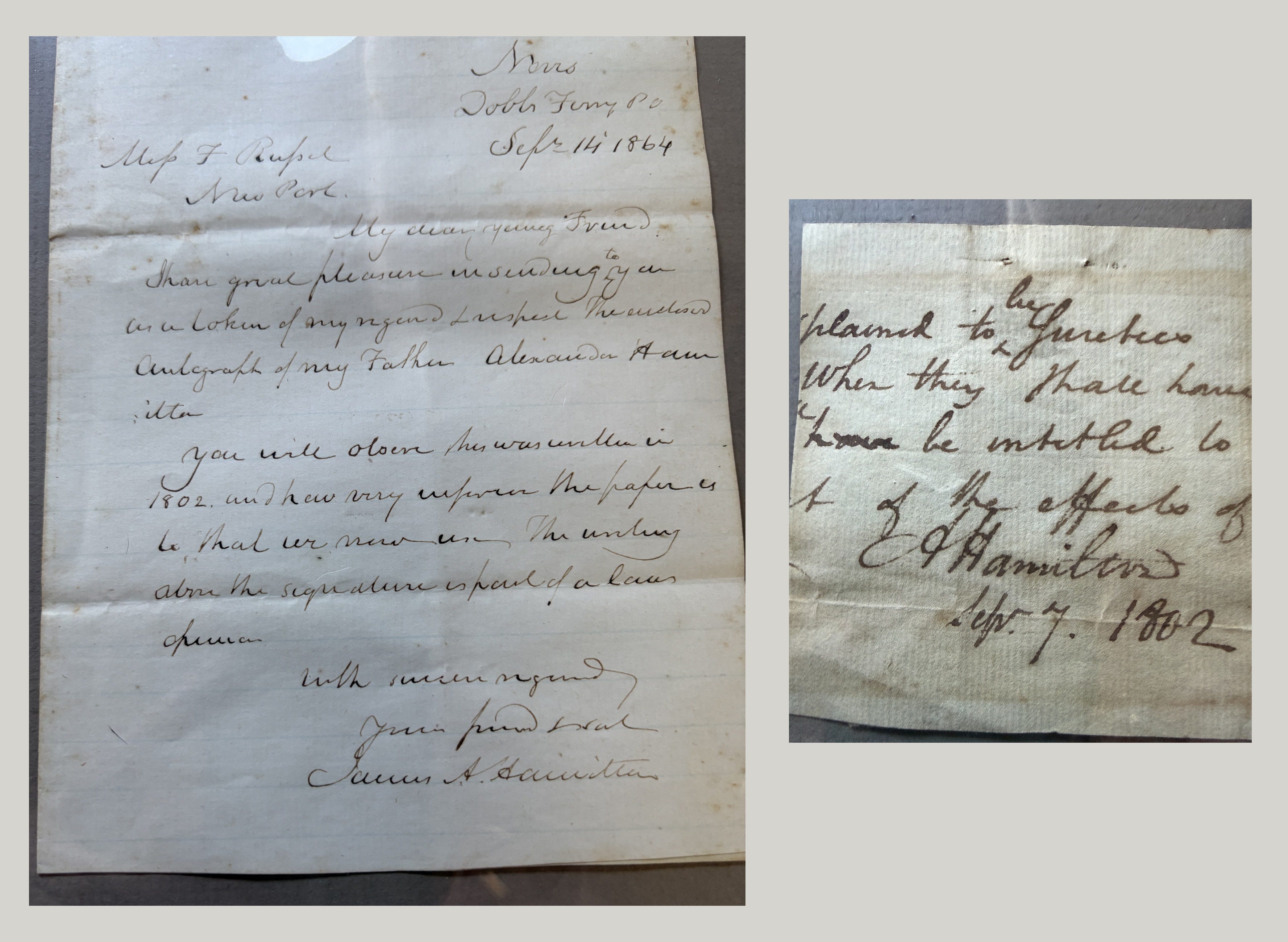
In September 1864 a seventy-six-year-old man sat down in his house above the Hudson and sent a young woman a present.
He named the house at the head of his letter, above “Dobbs Ferry PO” and the date: *Nevis*. Nevis is the island in the West Indies where his father was born. His father was Alexander Hamilton, and the present was his father’s signature.
Both pieces, the signature and the letter that came with it, have been in my house since 1996. They hang together in one frame. This is the twenty-third essay in a series about early-American documents, mostly ones I own, and what I find when I go back and actually read them. It is also about something I bought for the signature, and I’ll come to that.
The gift
Here is the letter, as far as I can read it through the glass:
Miss F Russel
New Port.
My dear young Friend.
I have great pleasure in sending to you as a token of my regard & respect the enclosed Autograph of my Father Alexander Hamilton
You will observe this was written in 1802. and how very inferior the paper is to that we now use. The writing above the signature is part of a law opinion
with sincere regard
Your friend [?]
James A. Hamilton

James Alexander Hamilton was the third son. He was sixteen when his father was killed in 1804, and he lived at Nevis, in what is now Irvington, New York, until his death in 1878.
I have not identified Miss F Russel. The *reading* is settled. I went over the address through the frame glass, with a magnifier: the double *s* in “Russel” is written exactly as it is in “Miss” two words earlier, and the capital of “New Port” has the same bowl and stem as the *R* of her surname, which a *Y* would not. The *person* is not settled. Newport in September was still a summer address, so he was probably writing to her where she was staying, not necessarily where she lived. “My dear young Friend” does not read like a stranger asking a famous family for a souvenir. It reads like someone he already knew.
He does not say why he sent it. Eleven lines, and not one of them gives the occasion.
The order of his attention
Read the second paragraph again.
The first thing he wants her to notice is the year. The second is the paper: *how very inferior* it is to what they used in 1864. Only after that, in the last sentence before he signs off, does he say what the words above the signature had once been part of.
When his father wrote those four lines, James was fourteen. Sixty-two years later he held the strip in his hand and pointed out the year and the paper. A man holding his dead father’s handwriting remarks on when it was written, and on what, before he gets to the words. That the slip had been cut from something longer, which he calls a law opinion, comes last, and almost as an afterthought. He is not apologising for it. He is describing it, the way you might tell someone that a cup was once part of a set.
What is left
The clipping is a strip of laid paper. Above the signature and the date are four partial lines. With my uncertainties left in, it reads:
[e]xplained t^[he] [G…]tees
When they shall have
[word struck through] be intitled to
[…]t of the effects of
AHamilton
Sep. 7. 1802
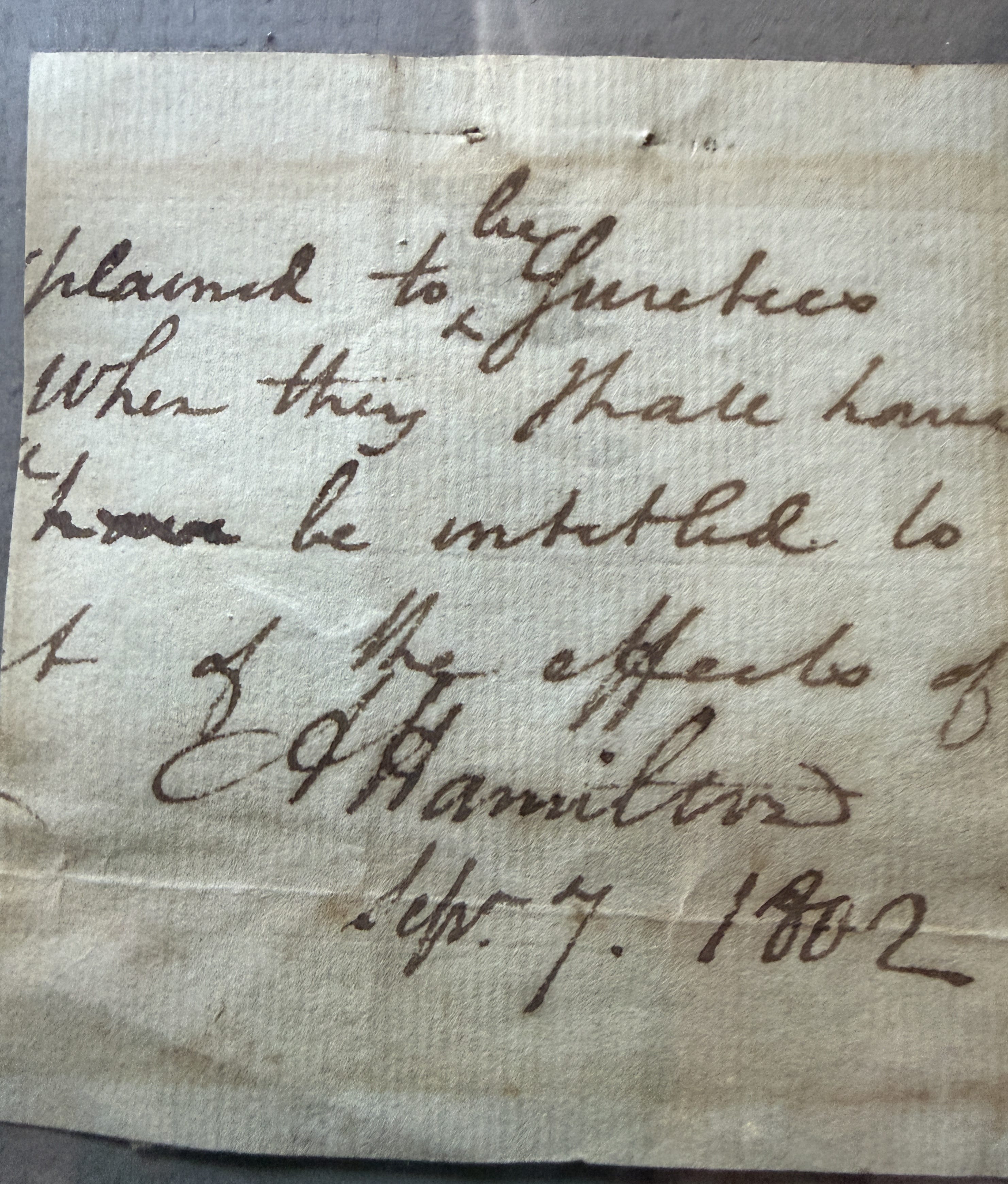
Some of this I can say with confidence. There is a caret in the first line, and in the third a word struck through. **Hamilton corrected it as he went.** What the caret puts in I am less sure of. I read letters completing *the*, but the stroke could be a *b*, which would give something else entirely, and the paper is discoloured just there, as though the spot had been worked over more than once.
At least two of the four lines begin in the middle of a word, and probably three, so the strip was cut on the left as well as above. The text carries on off the edge.
“Intitled” is the spelling of the period, and I have left it alone. The word at the end of the first line begins with a capital *G*. I cannot make the letters that follow it into any English word, so it stays in brackets. I could offer a guess that would make a better story. I am not going to.
The man who sent this one on wrote down, in one clause, what it came from, and the clause was still with it when it reached me.
I do not know who cut the sheet, or when, or whether the opinion was complete when the scissors reached it. I do not know whether the rest of it survives anywhere. The letter tells you what the writing was part of. It does not tell you what became of the rest.
There are two descriptions of the strip itself, and they disagree. The son, in 1864: “part of a law opinion.” The dealer’s invoice, in 1996: “cut from a letter with several words in his hand.” The two may not be far apart: the editors of Hamilton’s legal papers print documents they call “opinion letters.” I am recording both and choosing neither. As I remember it, the dealer’s catalogue described the son’s letter as well. I no longer have the catalogue.
*A brief note before I go further: I publish these primary-source essays on early-Republic financial history twice a month. If the format is your thing, a free subscription gets each one delivered by email as it comes out. It’s the easiest way to follow the project as it develops.*
Looking for the rest
This month I tried to find the document the strip came from. The printed edition of Hamilton’s legal papers indexes his cases alphabetically by name, with no dates. His published papers, and the edition of his law practice, show at least four matters live that autumn: an arbitration over land in northern New York; the settlement of a large debt Aaron Burr owed a London merchant; a trust, dated three days before the clipping, naming Hamilton as trustee to support Robert Morris’s wife, and Morris if he survived her; and a New York merchant’s bankruptcy. I read what I could reach of each. None produced a document dated the seventh, and none matches the surviving words closely enough to claim. The printed papers of the arbitration I did not order; that door is still open.
So the clipping stays unidentified, and the reason is in the object itself. **The part of the sheet that would say who it was written to, and about what, is the top. The scissors kept the foot.**
Why it is on my wall
I should say how it came to me. I bought it in 1996 from a dealer in Concord, New Hampshire. My interest at the time was only a clipped autograph. The letter came with it. I did not read either of them the way I have read them this month.
Which means that in 1996 I wanted what Miss Russel was sent: the name at the bottom.
The paper
It took me until this autumn to look properly at the four lines above the name. They are Hamilton on the seventh of September 1802, working: putting a word in, striking one out, writing about something he spelled with a capital G, and about when they would be entitled to part of someone’s effects.
I cannot say whose effects, or for whom he was writing. What the strip gives instead is not a case. It is a man in the middle of a sentence, choosing a word, deciding against another, on a Tuesday twenty-two months before Weehawken.
He noticed the paper. I noticed the name. The words were there the whole time.
Next in the series: one sheet from 1864, ten endorsements, and seven generals, Meade and Sheridan among them.
Thanks for reading.
— Paul
**Sources.** The clipping (signed “AHamilton,” dated Sep. 7. 1802) and the covering letter from James A. Hamilton, “Nevis, Dobbs Ferry PO, Sepr 14’ 1864,” are in the author’s collection, framed together; both were transcribed from photographs taken through the glass, with doubtful readings checked by eye against the originals; uncertain readings are bracketed. Acquired from William Linehan Autographs, Concord, New Hampshire, 1996. On James A. Hamilton’s house at Nevis, see Columbia University’s history of Nevis Laboratories and Mount Vernon’s biography of James A. Hamilton. On Hamilton’s legal practice: Julius Goebel Jr. and Joseph H. Smith, eds., *The Law Practice of Alexander Hamilton*, vol. IV (Columbia University Press, 1980), and the tables of cases in vols. IV and V. Founders Online (National Archives) was searched for 1802, October 2026.
Thank you for doing your analysis of the clipping too. This gets to be maddening sometimes. It’s no wonder why schools in NJ stopped teaching cursive. LOL. I noticed that there are pin marks on top of the clipping and the letter too, indicating that they were attached. I hope James didn’t trim it to fit in an envelope.
I lean towards your reading of "b" following the caret in the first line, as the word following "[e]xplained" is almost certainly "to" rather than a stray "t." Reference the similar form of the the "to" (though uncrossed) following "intitled.""be" before "intitled" is also instructive, as like the word following the caret, the first letter is not closed off with a complete circle. The "h"s in "they," "have," and "the" also do not have the pronounced loop in the word following the caret. "they" is particularly useful, because the construction should mirror that of "the." "be" makes logical sense in the sentence, which would read "[e]xplained to be [G...]tees."
A lot to say for a small word. Unfortunately, I don't have a clear reading on the mystery "...tees" word following.