

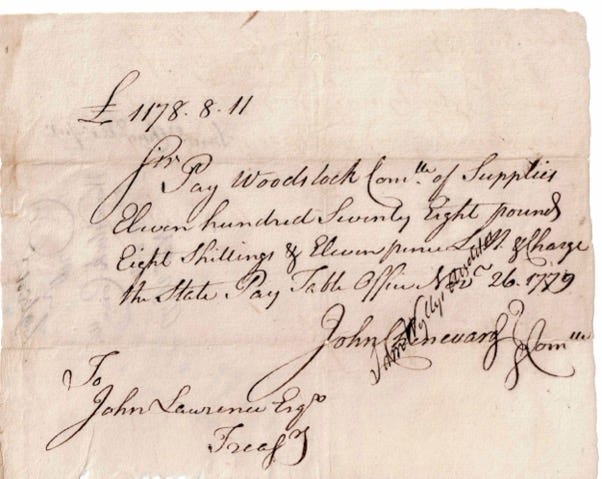
The front of the paper is seven lines long and does one thing.
£1178.8.11
Pay Woodstock Comee. of Supplies Eleven hundred Seventy Eight pounds Eight Shillings & Eleven pence [Lawfull Money?] & Charge the State
Pay Table Office Novr 26. 1779
To John Lawrence Esqr Treasr
That is the whole instrument. A committee in Hartford tells the Treasurer of Connecticut to pay a committee in Woodstock. Somebody signs it. It is about eight inches by six, it has been folded for two and a half centuries, and there is nothing remarkable about it at all.
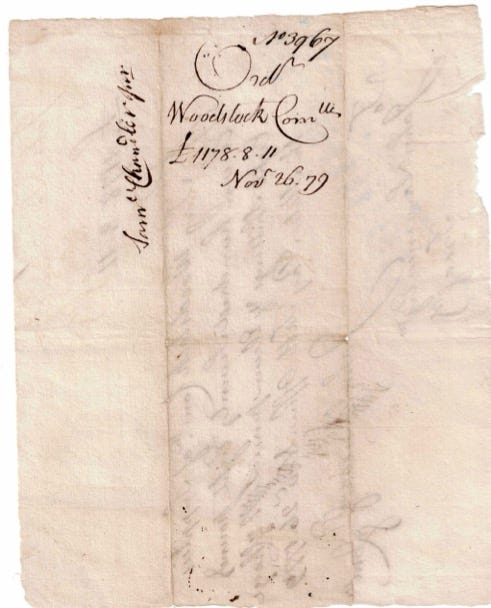
Then you turn it over, and there is a number.
No 3967 / Ord / Woodstock Comee. / £1178.8.11 / Novr 26.79
Why a number is the point
I have spent most of a year on a different piece of paper — a bill of exchange Francis Hopkinson signed in Philadelphia in September 1778, number 645, payable in Paris. The single most useful day I have had on it was the day I sat in a reading room at the Historical Society of Pennsylvania and found the line in Hopkinson’s own account register that recorded issuing it. Number, date, payee, amount. Four things matching.
That line proved the bill was real in a way the bill itself could not. A document says what it says. A document that appears in somebody else’s records says what it says and that an office agreed with it.
Getting to that line took a year, a hundred and fifty miles, an appointment, a call slip, and a paragraph of plain description because the volume I wanted had no call number.
The Connecticut pay order came with its line written on its own back.
“No 3967.” That is not a collector’s mark and it is not a dealer’s stock number. It is the Pay-Table Office’s own filing series — the number this order was given when it was entered in the office’s books, docketed in the same hand, on the same day, so that when the Treasurer paid it somebody could find it again.
The record and the instrument are the same object. I did not have to go anywhere.
The two offices, and the man who held both
Here is the part that made me buy it.
The order was addressed to John Lawrence, Treasurer of Connecticut from 1769 to 1789. Twenty years in the post, straight through the war.
Lawrence was also United States Commissioner of Loans for Connecticut.
I have been writing all year as though there were two financial systems in the Revolution — the states on one side, the Continental Congress on the other. It is a convenient way to think and it is how the paperwork is usually filed. Hopkinson’s bills of exchange are federal: drawn by the Treasurer of Loans in Philadelphia on an account in Paris, countersigned by a Continental Loan Office commissioner in whichever state issued them. Pay orders like this one are state: Connecticut money, Connecticut committee, Connecticut treasury.
But in Connecticut, in 1779, the two systems arrived at the same desk.
The man who received this order — a state instruction to pay a town committee in depreciated state currency — was the same man administering the federal loan office in that state, the machinery that borrowed from Americans in hard money and paid them interest in bills drawn on France.
That is not a coincidence and it is not a scandal. It is what a small state’s administrative class looked like. There were not enough men who could keep books to give each system its own. The separation I have been carrying around exists mostly in the way the surviving papers are catalogued — federal records in one place, state records in another — and Lawrence’s in-tray did not observe it.
What was actually being paid for
The Woodstock Committee of Supplies was a town-level body procuring provisions for the war. Beef, grain, blankets, teams — the things an army eats and wears, bought locally, from neighbors, on the state’s credit.
And the sum is large. Eleven hundred and seventy-eight pounds, eight shillings, eleven pence.
I am not going to tell you what that is worth, because by November 1779 the question barely had an answer. Currency had been depreciating for years and the depreciation was accelerating. A number like this is a nominal figure in a currency that was losing its footing, and any modern conversion I offered you would be a guess dressed as arithmetic.
What I can say is what the paper does. A town bought supplies. The state acknowledged it owed them. The acknowledgment was written down, numbered, and filed. That is the whole of public finance in a war, and the fact that the money was going bad underneath it is precisely why the acknowledgment mattered.
Which is the same story as the bills of exchange, arriving from the opposite direction. Congress could not pay its lenders in anything worth having at home, so it drew on Paris. Connecticut could not pay Woodstock in anything worth having either, so it wrote an order and gave it a number.
Both are promises. One crossed an ocean and one crossed the room.
The office it came out of
One more thing, because it surprised me.
The Committee of the Pay Table was Connecticut’s war-finance office, sitting in Hartford, and over the course of the war its membership included Oliver Ellsworth — later Chief Justice of the United States — and Oliver Wolcott Jr., who would succeed Alexander Hamilton as Secretary of the Treasury.
The office that produced this seven-line order was, among other things, where two men learned public accounting before doing it at a national scale.
I cannot tell you that either of them was in the room on 26 November 1779; I have not established the roster for that month and I am not going to assume it from a list that covers the whole war. But the institution is the point rather than the individual. Somebody in Hartford in 1779 was keeping a numbered series of orders in a ledger, and the habit of doing that is the thing that later made a Treasury possible.
Now turn back to the front
I have been talking about the back of the paper. The front has something on it too, and I nearly missed it, because I was reading the description instead of the document.
The order came to me with a catalogue entry, and the catalogue gives the signer’s name as Chenward.
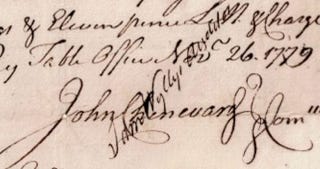
It is not Chenward.
Look at the signature at magnification and the thing the catalogue read as a w is not a w. It is an ev — two letters, joined. And the way you can tell is not by comparing it to some other document in some other archive. It is by comparing it to the same word.
The name begins Chen-. That e is written plainly, at the front of the word, by the same hand, in the same stroke of the pen, two letters earlier. Set it beside the disputed cluster and they are the same letter. What follows it is a v, not the second half of a w.
The name is Chenevard.
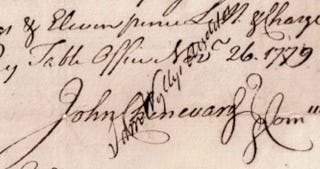
That is a small correction and I am not making a meal of it. But I want to be clear about the method, because it is the cheapest good method I know: when you are unsure of a letter, do not go looking for an exemplar somewhere else. Look at the same letter, in the same word, by the same hand, a few strokes earlier. A scribe is more consistent with himself over two inches of paper than any reference table will ever be with him.
I have been wrong about a name in print before — I spent a year calling a man Renaudel when the bill had been spelling him Renaudet on its own face the whole time. So I asked a second pair of eyes before writing this, and read it twice from a high-resolution scan. Chenevard both times.
And while I was in there, I found something the catalogue does not mention at all.
There is a second signature. A different hand — smaller, darker ink, a different pen — written across and through the first, cutting diagonally over the baseline. It is not a flourish and it is not a stray mark. It is somebody else signing the same order. The description of this document records one signer. The document carries two.
I read the second as Sam^ Wyllys — “Sam” with a clean, deliberate abbreviation stroke above it, not a compressed “uel,” and then a natural gap before the surname of the kind you get when a man is writing his name rather than making a mark.
And here I made a mistake worth showing you, because it is the mistake this kind of document is built to cause.
My first reading was Sam^l — Sam with a superscript l, which is the ordinary eighteenth-century short form of Samuel. There is certainly a tall stroke standing right where that l would go.
It is not an l. It is not even part of this signature. It is an ascender belonging to Chenevard’s name, running up through the other man’s, and the way you can tell is the ink.
Look at the two hands side by side at magnification and they do not match. Chenevard’s line is lighter, browner, thinner — a finer nib, or a drier pen. The signature crossing it is darker, heavier, blacker, laid down with more pressure. Once you can see that difference you can sort the strokes, and the tall “l” sorts into the wrong signature.
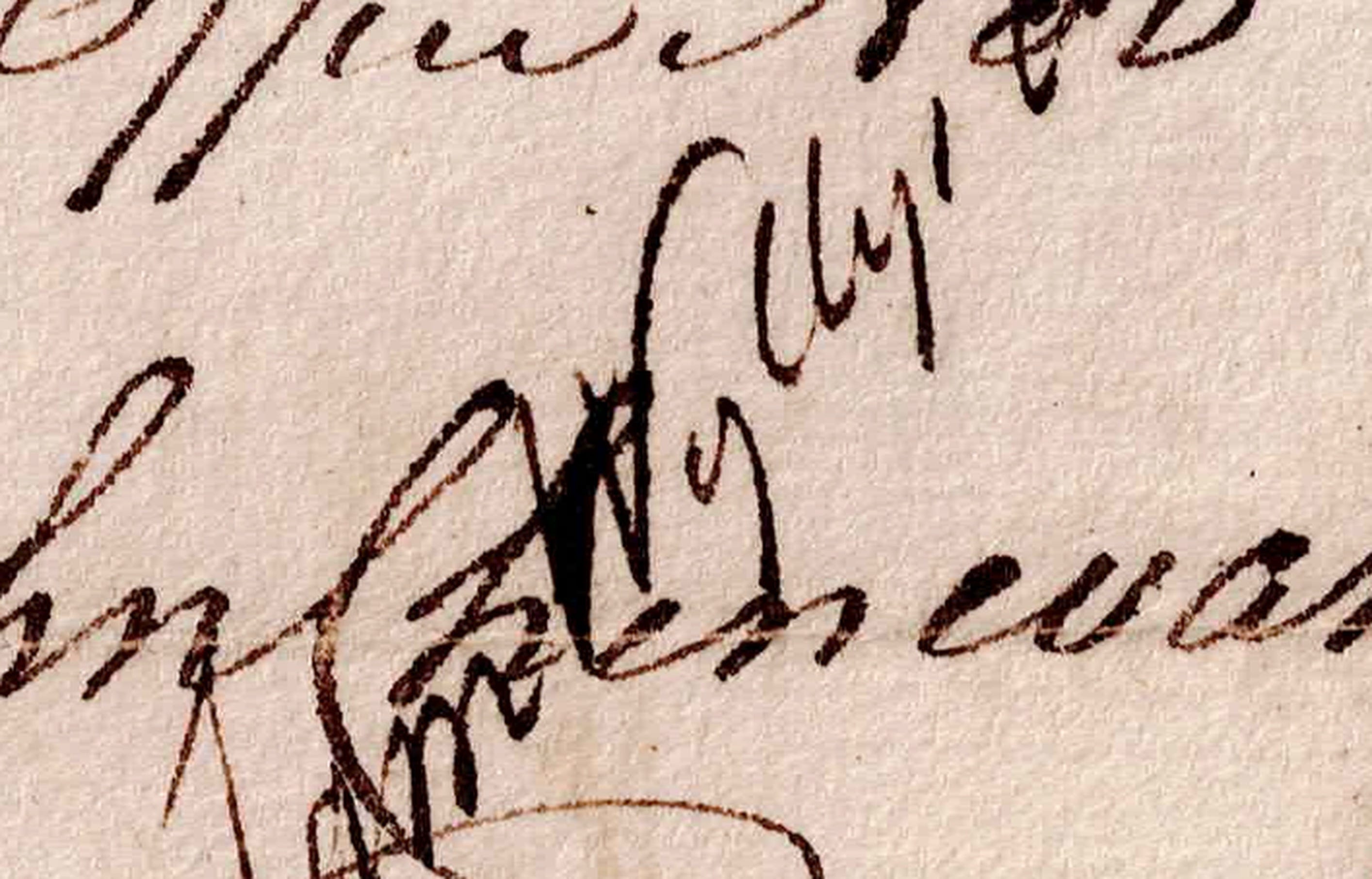
Which is the second cheap method, and it is worth having: when two hands overlap, do not read the letters first. Assign the strokes to their owners first — by ink tone, by pen weight, by line thickness — and only then read what is left. Otherwise you will helpfully build a letter out of two men’s pens and then find a name that fits it.
So: Sam^ Wyllys, not Sam^l. A small difference, and I only found it because somebody looked again after I had already decided.
Now, I want to hold these two names apart, because I am much more sure of one than the other, and the difference is the whole business.
Chenevard I can prove from the document alone. The e is there, in the same word, in the same hand. Nothing outside the sheet is required. If you disagree, we can disagree about a thing we are both looking at.
Wyllys I cannot. What I have is my reading, a second reader who arrived at the same name independently, and then two pieces of outside corroboration — and outside corroboration is exactly what makes a wrong reading feel right, so it deserves naming rather than leaning on.
The first is that Samuel Wyllys sat on the Committee of the Pay Table — a general, later Secretary of the State of Connecticut for thirteen years. A name that belongs on this office’s paper.
The second is better, and it is the reason I am willing to put the name in print at all. A Pay-Table document from 1781, two years after mine, is described as signed by three members of the committee — two of them ordinarily, and Samuel Wyllys signed vertically, across the sheet.
That is not a name matching a name. That is a habit matching a habit. The thing that made the second signature on my order hard to read in the first place — that it runs diagonally across somebody else’s — turns out to be how this particular man signed this particular office’s paper.
I still call it a reading. An exemplar from the Connecticut State Library would make it a fact, and that is a letter I can write.
What I still do not know
Who the second signer is. See above. I would rather name him correctly in six months than plausibly this week.
What happened to No. 3967 afterwards. The order was numbered so it could be found again. Connecticut’s Revolutionary war records survive in quantity at the state library and in the Comptroller’s series. Somewhere in them, in principle, is the other end of this: the entry recording the order received, or paid, or not paid.
I have done this once before, with a bill of exchange and a register in Philadelphia, and I know roughly how long it takes. The difference is that this time I already have the number.
The thing I keep noticing
In November 1779 a clerk in Hartford wrote this order, gave it a number, and docketed that number on the back so the office could find it again. He got it right. Two hundred and forty-seven years later, the description that came with the document gets the signer’s name wrong and does not mention that a second man signed it.
I do not say that to be hard on anybody. Cataloguing at volume is difficult and the hand is not easy.
But it is worth saying that the document has been more accurate about itself than its description has — and that this is not the first time this year I have found the catalogue and the object disagreeing, with the object winning.
A scheduling note before I go. From October these essays move to twice a month rather than weekly, and the reason is straightforward: I want more time in the archives and less at the keyboard. The essays have been arriving faster than the research that feeds them, and I would rather fix that than keep up with it. Nothing else changes. Still free, still one document at a time.
Thanks for reading.
— Paul