

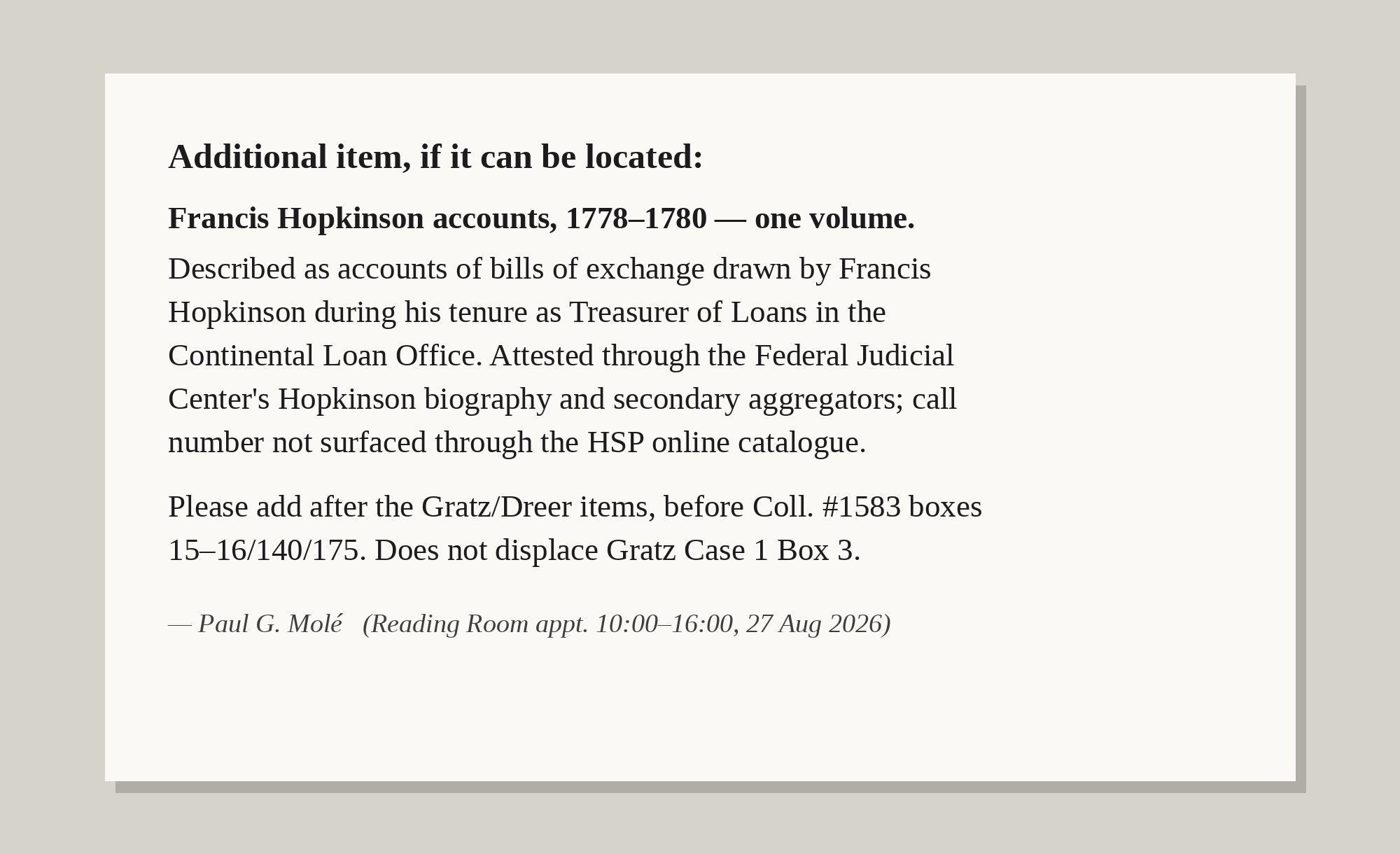
Two weeks ago I published the walk-up slip I handed across the desk at the Historical Society of Pennsylvania — the paragraph I printed because the volume I wanted had no call number. Near the end of it there is a line I wrote without thinking about it much:
Please add after the Gratz/Dreer items, before Coll. #1583 boxes 15–16/140/175. Does not displace Gratz Case 1 Box 3.
I have read that sentence back a dozen times since. I was asking a reading room not to bump a box out of my queue. What I did not stop to ask was why the box has that name on it, or why a research library in 2026 is still counting in Cases.
The answer turns out to be a man, a filing system, and a purchase he regretted.
Why I am spending an essay on a filing cabinet
I nearly didn’t write this one. A dead collector’s arrangement of his boxes is, on the face of it, the driest thing in the building.
Here is what changed my mind.
An archive’s arrangement is not neutral and it is not clerical. It is an argument about what a document is for — made once, by somebody with an opinion, and then inherited by everybody who comes after. The categories a collection is cut into are the questions it has agreed to answer. Anything outside them is still in the building. It is simply not reachable by asking.
And historians write what they can find. If the index is built around famous men, then the history that comes out of it will be a history of famous men — not because that is what mattered at the time, but because that is what got indexed. Nobody has to intend this for it to happen. It happens by filing.
I am not raising a scandal. Nobody did anything wrong here, and I will come to why I think the people responsible had perfectly good reasons. But it means that when I cannot find something, the first question is not did it survive. It is what was the person who filed it trying to answer, and was it the same thing I am trying to answer.
That is a question with a name and a date on it. In this case the name is not the one on the boxes.
Simon Gratz
Simon Gratz was a Philadelphia lawyer. He was born in 1840 and died in 1925, and the Historical Society’s finding aid says he began collecting autographs at the age of seventeen and did not stop.
By the end he had assembled roughly a hundred and seventy-five thousand manuscripts, portrait engravings and lithographs. He dealt with collectors and with dealers in Paris, London, Berlin, New York and Philadelphia. He kept what he called his Autograph Journals, recording his transactions from 1861 until the year he died. On the first day of 1925 he noted in them that between his sales and his exchanges the whole collection had, on balance, “cost less than nothing.”
He gave it to the Historical Society. He deeded it in 1917 and the transfer was not finished until after his death. He had become a vice-president of the Society the year before he signed it over, and by the time he resigned from its board he had served more than fifty-one consecutive years.
Part of what he gave is Collection 0250A. It runs to a hundred and ninety linear feet in six hundred and thirty-three boxes, and the documents in it are dated from 1343 to 1928.
And that answers the small question I started with. The boxes are grouped into Cases, about forty boxes to a Case. Nobody at the Historical Society sat down in 2014 and invented that unit. It is furniture. Somewhere there was, or is, a physical case that held forty boxes, and a hundred years later a researcher in a reading room is still asking for things by which piece of furniture they were put in.
That is the thing my slip asked not to displace.
What it is arranged by
Here is the sentence in the finding aid that stopped me.
The collection is arranged by category of achievement.
Read a little of the inventory and you see exactly what that means. There is a run of boxes for GENERALS OF THE REVOLUTION. There is one for COLONIAL GOVERNORS, and one for MAYORS OF PHILADELPHIA, and one for AMERICAN HYMN WRITERS. There are boxes for BRITISH PRIME MINISTERS, for POPES, for NOTABLE AMERICAN WOMEN, for CONFEDERATE NAVY, for EXPLORERS, DISCOVERERS, MATHEMATICIANS, ASTRONOMERS — four professions sharing one label because all four are the sort of thing a man can be.
Within each category, the names run alphabetically, and the boxes are labelled by where the alphabet starts and stops.
So the whole collection is a very large answer to a single question: what was this person?
A brief note before I go on: I publish these primary-source essays on early-Republic financial history, and they’re free. If this is your sort of thing, a subscription puts each one in your inbox as it comes out.
Case 1, Box 6
I went looking for Francis Hopkinson, because I have spent a year reading his handwriting.
He is there. Case 1, Box 6. The label reads:

He is filed under OLD CONGRESS — that is HSP’s inventory term, capitals and all — and he is the far end of the alphabetical run, the last name before the box closes and the next one starts at Hornblower.
Now. Francis Hopkinson was a member of the Continental Congress, so the heading is not wrong. He signed the Declaration of Independence for New Jersey. Filed under Old Congress, he is exactly where a nineteenth-century collector would expect to find him.
But the Hopkinson I have been reading was Treasurer of Loans. He signed bills of exchange, by the hundred, in sets of four, drawn on an account in Paris, to pay interest to Americans who had lent money to a Congress that could not pay them at home. He countersigned them alongside a commissioner in whichever state had issued them. That is the work that filled his days for those years, and it is the reason his signature is on the two sheets I own.
There is no category of achievement for that. “Treasurer of Loans” is not a kind of man. It is a job somebody did at a desk, and a filing system built around what a person was has nowhere to put it.
The finding aid answers who. I keep arriving with a question about what.
The part I did not expect
I assumed the arrangement was Gratz’s. It isn’t.
In 1881 he bought a collection of ninety thousand items that had been assembled by William Buell Sprague, who had died five years earlier and whom the finding aid identifies only as the author of Annals of the Pulpit. He paid twenty thousand dollars for it. His own verdict on the purchase, quoted in the finding aid, is that it was “probably twice as much as it was worth.”
And then this, which I have now read about fifteen times:
Despite his misgivings about the Sprague collection, assimilation of the material left its mark upon the Gratz Collection: Sprague’s system of arrangement by category survives almost intact in the first section.
The first section.
I would like that to mean Case 1, because Case 1 is where the inventory begins and Case 1 is where Hopkinson is, and because it would make a much better story. The finding aid does not say. Six hundred and thirty-three boxes is a lot of collection for the phrase “the first section” to be carrying on its own, and I am not going to decide what it means on my own behalf. That is a question for the people who hold it, and it is going in my next letter to them.
But the larger fact does not depend on my getting the lucky answer. Somewhere in this collection — quite possibly in the part where Hopkinson sits — the arrangement a researcher meets is not Simon Gratz’s arrangement at all. It is William Buell Sprague’s: bought in 1881 by a man who thought he had paid double for it, absorbed into a much larger collection, carried into a public institution in 1917, and still standing.
A dead man’s filing cabinet, purchased second-hand and under protest, is part of the shape of how you look for anybody in these boxes today.
Why he did it
Gratz did not invent the arrangement. But he kept it, and he could have done otherwise — he had forty-four more years and a very definite view of what an autograph was for. He left it as he found it, which is its own kind of decision.
So it is worth asking what he thought he was doing, and he wrote it down. From his book on autograph collecting, quoted at length in the finding aid:
An autograph letter from the hand of a noted man is the closest personal memorial of him that can be had. Here we have the identical paper that his hands touched and on which he wrote the words we read—words expressing thoughts as they emanated from his brain. We almost feel as if we were in direct contact with the writer.
That is not a foolish thing to want. It is most of why anybody keeps anything.
But look at what it commits you to. If the point of the paper is contact with the man, then the man is the unit, and you will file by the man, and the arrangement will be alphabetical inside a category of fame. Everything else on the sheet — who it was addressed to, what it settled, what it was cut away from — becomes background to the signature.
Gratz was reading the front. I have spent a year on the backs.
Neither of us is wrong about what a document is. We are asking it different questions, and a filing system can only answer one of them.
Which brings me to my own position
I should say the uncomfortable part out loud.
I own two Continental Loan Office bills of exchange. They are loose sheets. Last week I wrote about the left-hand edge of each one — cut deliberately along a wavy line, no two curves alike, with two short pen strokes running off the edge and stopping. I ended that essay by saying that whatever they were cut away from is not here.
I did not buy them from Simon Gratz. But I bought them, and they came to me as single sheets, and they came to me that way because for two centuries there has been a trade in exactly that: documents valued for the name on them, separated from whatever they were part of, and sold on one at a time.
I am a customer of the thing I have just spent this essay describing. The essays I write depend on my owning objects that reached me detached, and my complaint about detachment would be a good deal more convincing if I had come by them some other way.
I do not know what to do with that except say it.
The four boxes
One more thing from the finding aid, in the processing notes, where HSP records what its own archivists ran into:
There are some Case/Box units that appear to be either missing or misplaced. The following is a short list of units noticed “missing” during the processing of the collection: Case 7/Box 1; Case 9/Box 24; Case 16/Box 8; Case 16/Box 20.
You can watch it happen in the table of contents. The inventory runs Case 6/Box 40, and then the next entry is Case 7/Box 2.

I find that oddly reassuring. A hundred and seventy-five thousand items, fifty-one years on a board, a deed of gift, a finding aid published in 2014 — and four boxes that are somewhere else, or nowhere, and are listed as such in public by the institution that holds them.
That is what an honest catalogue looks like. It tells you where it stops.
What I am actually asking for
Not a different arrangement. Six hundred and thirty-three boxes are not going to be re-sorted to suit a retired man in New Jersey with a question about interest payments.
Only this: that the arrangement is one. That somebody chose it. That it was chosen to answer a question, and the question may not be mine. And that the thing I want may be sitting perfectly safely in a box labelled for something else.
Which is, I notice, the third time I have reached that conclusion this year, and all three times about the same building. In August it was a card catalogue that files letters by the person who signed them, so that a lifetime of correspondence to a man scatters under other men’s names. Two weeks ago it was a volume the modern catalogue does not return on any wording I could invent. Now it is an arrangement inherited from the eighteen-eighties that has no room in it for what a man did for a living.
The catalogue is not the collection. It is somebody’s opinion about the collection — and opinions have dates on them.
I got lucky twice. Both times because I asked a person instead of a search box, and the person knew which opinion I had run into.
A scheduling note before I go. From October these essays move to twice a month rather than weekly, and the reason is straightforward: I want more time in the archives and less at the keyboard. The essays have been arriving faster than the research that feeds them, and I would rather fix that than keep up with it. Nothing else changes. Still free, still one document at a time.
Soon: I have a letter Francis Hopkinson wrote to Paris in December 1778, in which he lists, state by state, the numbered bills he had just put into circulation. I have a bill he signed in Philadelphia that September. I am going to find out whether mine is on his list. Thanks for reading.
— Paul