

Last week I wrote about finding a bill of exchange I own recorded in the ledger of the office that issued it — line 645, in a clerk’s hand, at the Historical Society of Pennsylvania.
This is the eighteenth piece in a running project on the primary-source financial history of the early Republic, and it is the practical footnote to that one. Because the thing I keep turning over is not the entry. It is how the volume got onto the desk in the first place — which was not by any of the means I had spent weeks preparing.
I arrived with a thirteen-item pull list. Collection numbers, box numbers, case numbers, all verified, all correctly formatted, sequenced by priority against a six-hour day. It was a good list and it took weeks to build. Most of it never got used, and the item that made the trip worth taking was not on it.
The slip
A few days before the visit I had found a reference to a volume that had no call number attached to it anywhere. Two sources attested it existed. Neither gave a call number, and the catalogue search returned nothing on any phrasing I could invent.
HSP’s paging rules are three call slips at a time, one item on the desk at a time, and nothing pulled in advance. A slip with no call number is a slip that comes back rejected, and a rejected slip costs a paging cycle you do not get back.
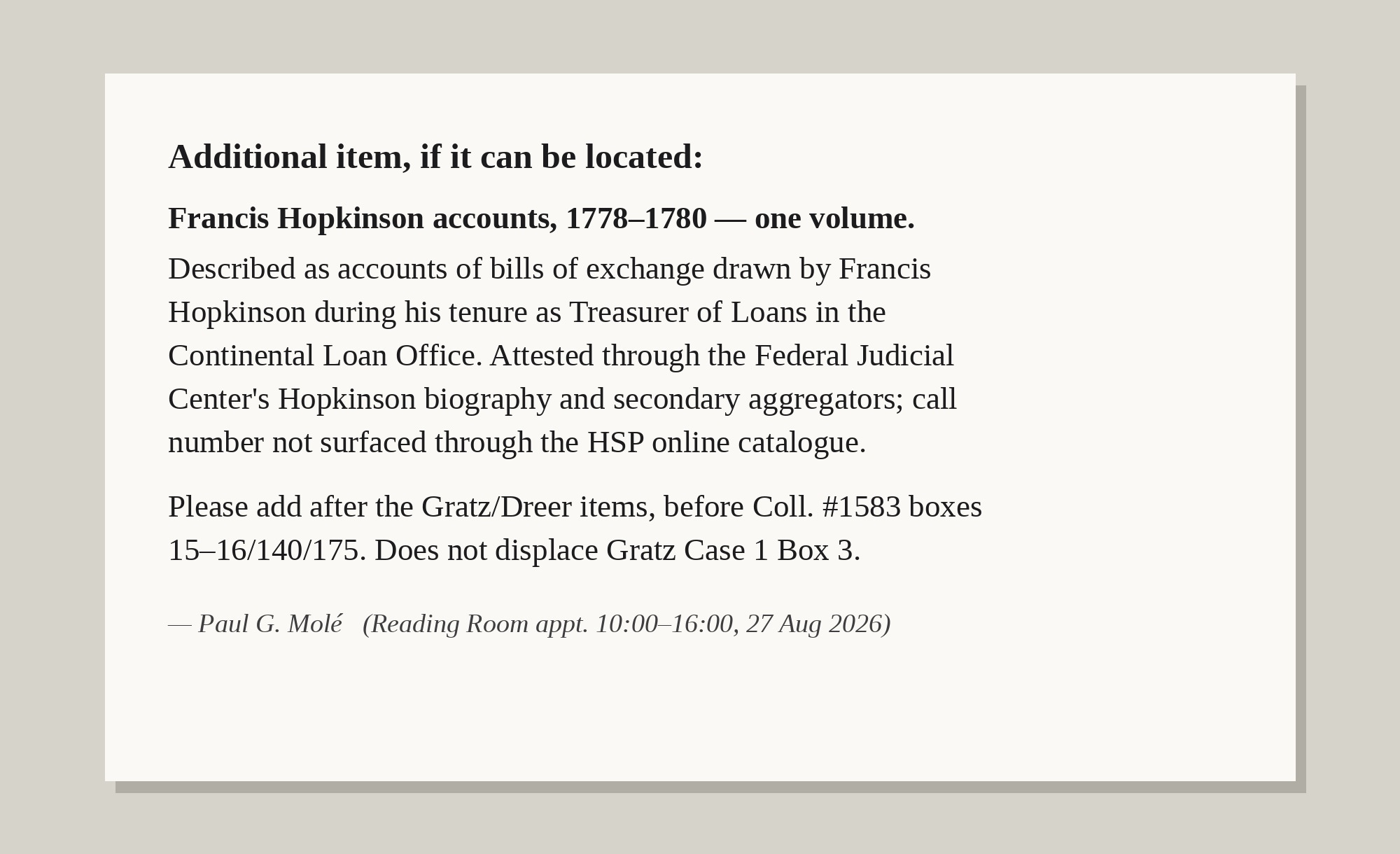
So instead of a call slip, I printed this and handed it across the desk when I registered:
Additional item, if it can be located:
Francis Hopkinson accounts, 1778–1780 — one volume. Described as accounts of bills of exchange drawn by Francis Hopkinson during his tenure as Treasurer of Loans in the Continental Loan Office. Attested through the Federal Judicial Center’s Hopkinson biography and secondary aggregators; call number not surfaced through the HSP online catalogue.
Please add after the Gratz/Dreer items, before Coll. #1583 boxes 15–16/140/175. Does not displace Gratz Case 1 Box 3.
— Paul G. Molé (Reading Room appt. 10:00–16:00, 27 Aug 2026)
That is the whole thing, exactly as it was printed. Eighty-odd words and no call number, because there wasn’t one.
Someone at Research Services found it.
It is not called that, as it turns out. HSP’s current citation is Francis Hopkinson papers, 1778–1780 (Am .8101) — which I learned afterwards, from the institution, and which is one more instance of the thing this essay is about.
Why that worked, when the good list did not
I have been thinking about this for two weeks and I do not think it was luck.
A catalogue answers the question you asked. A person answers the question you meant.
When I type a phrase into a search box, the machine performs exactly the operation I specified against exactly the records that were indexed, and returns an honest nothing when my phrasing and the cataloguer’s phrasing fail to meet. It cannot tell me that it knows what I’m after but files it under a different word. It cannot say oh, that’ll be in the old numbered guide. It has no idea I’m in the building.
The slip is a different kind of query. It does not ask do you have call number X. It says here is what the object is, here is roughly when, here is whose office it came from, here is what it should contain — do you recognise this? That question can be answered by somebody who has spent years walking past a shelf.
And the honest reason it worked is not that I was clever. It is that the thing I was looking for was not findable the other way.
At some point in the day I said out loud what had been bothering me since I first heard of the volume: that it did not come back from the catalogue on any wording I could think of. She did not seem surprised. She said there were other tools available. Then she brought up a plain page I had never seen — the Society’s legacy numbered manuscript guide, an older list of collections that sits outside the modern search index — and found the entry immediately.
I want to be exact about what that means, because I have been telling this story to myself the wrong way round. It is not that the catalogue failed and I worked around it afterwards. It is that the catalogue has a known edge, the people who work there know where it runs, and they keep a second instrument for the far side of it. None of that is hidden. It is simply not something a search box can tell you, because a search box cannot say you are asking the wrong index.
A brief note before I go further: I publish these primary-source essays on early-Republic financial history weekly. If the format is your thing, a free subscription gets each one delivered by email as it comes out. It’s the easiest way to follow the project as it develops.
This is the second time this exact thing has happened to me at the same institution. In an essay in early August I wrote about a card catalogue of nearly a million images, digitised and unsearchable, which files letters by the person who signed them rather than the person who received them — so that a lifetime of correspondence to the man I was researching sits scattered under other men’s names. The catalogue answered honestly both times. The question was in the wrong place both times.
I do not think this is a criticism of anybody. Every archive that has been collecting for two hundred years has a seam in it — a point where one system of description stopped and another started, with a body of perfectly good holdings left on the far side. The catalogue is not a map of what an institution owns. It is a map of what somebody had the time and the funding to describe, in the vocabulary available when they described it.
The slip, generalised
If you work without an institution behind you, this is the cheapest tool I know, so here is what I would keep in it.
One. What the thing is, in plain words. Not a search string. A description a human can picture: one volume, accounts of bills drawn, 1778–1780.
Two. Where you heard about it, and how good that source is. Attested through the Federal Judicial Center’s biography and secondary aggregators tells a librarian precisely how much to trust me, and lets them discount it without having to ask.
Three. What you already tried. Call number not surfaced through the online catalogue is the single most useful sentence on the slip. It stops a busy person repeating my work, and it quietly signals that they are not the first thing I reached for.
Four. Where it sits in your priorities, and what it must not displace. This is the one people leave off. A reading room runs on a paging budget, and saying this does not displace Box 3 makes the request small enough to say yes to.
And print it. Handing over a sheet of paper is a different act from describing something across a desk while somebody tries to remember it.
What is actually in the finding aid
The thing I got wrong for weeks was thinking of preparation as building the best possible list of call numbers — as if the reading room were a warehouse and my job were to arrive with accurate coordinates.
The reference librarian is not the interface to the collection. They are part of it — the part that holds everything the description didn’t capture, the migrations, the legacy guide nobody links to, the shelf that has been there since before the search box existed.
That there were other tools available — I have thought about what she said more than anything else anyone said to me that day. It is not a workaround and it is not a secret. It is a professional telling an amateur that the instrument he brought is one of several, and that she knows which one this question wants. That knowledge is genuinely in the building and it is genuinely available, and there is exactly one way to query it, which is to put a sentence in front of a person and wait.
I should be honest about what I expected, which was not much. I put the odds at a coin toss, and I think I was being generous with myself.
What I had not prepared for was the ceremony. They were entirely accommodating about it, and when the volume came out they set it up on cushions so I could examine it. There is a particular feeling in watching a book you had been half-convinced you would never get in front of you be handled that carefully.
Then it hit me. This was a large ledger, and nobody was going to point at the line. I was going to have to read it, one entry at a time, until 645 came up.
That is the part nobody tells you about a good day in an archive. The victory is being handed the book. Everything after that is just looking.
I got six hours in that reading room. The slip took a minute to hand across the desk. It returned more than the rest of the day combined, and I will write one before every visit I ever make again.
Next week: back to the object. Two bills of exchange, a year apart, both signed by Francis Hopkinson as Treasurer of Loans — one countersigned in Pennsylvania, the other in Massachusetts. I had been thinking of the Continental Loan Office as an office. Thanks for reading.
— Paul