

For a year I have been looking for a man named Adrian Renaudel.
He is the payee on a Continental Loan Office bill of exchange I own — a third bill, No. 645, drawn on 25 September 1778 for eighteen dollars, ninety livres tournois, signed by Francis Hopkinson as Treasurer of Loans and countersigned by Thomas Smith.
I should admit something at the outset, since this is going to be an essay about records. I do not remember acquiring it. In fact I forgot that I even acquired it. I have no story to give you about a fair, or a dealer, or a decision made across a table — the bill was simply among my things, and its arrival left no mark on me whatsoever.
Which is a small and private version of what had already happened to the bill itself.
This is the seventeenth piece in a running project on the primary-source financial history of the early Republic, and not the first to circle this one sheet of paper. In July I published an essay called In Search of Adrian Renaudel, which was an honest account of not finding him. The National Archives holds the register of the underlying loan certificates. The part of it that would have him in it is ordered by letter number — the number assigned to a piece of correspondence as it arrived at the office, in order of receipt, without regard to who sent it or what it was worth. You cannot ask it who somebody was. The archivist there opened the boxes, looked, and told me plainly that finding one name would mean the better part of a day of sequential paging by somebody standing in College Park. I did not make the trip and I did not hire anyone to make it for me, and I wrote that down, because a negative result is still a result.
I want to tell you what happened last Thursday, and then I want to tell you the part that is embarrassing.
The volume that was not on the list
I spent 27 August in the reading room of the Historical Society of Pennsylvania on Locust Street. The day was booked for a different purpose entirely — William Bingham’s Martinique correspondence, filed in the Gratz collection, which I have written about here before.
But I went in carrying one extra sheet of paper.
A few days before the trip I had come across a reference to a volume: Francis Hopkinson accounts, 1778–1780. One volume. Accounts of bills drawn by Hopkinson during his tenure as Treasurer of Loans. No call number. Nothing came back from HSP’s catalogue search on any wording I tried. The volume was attested in two places and locatable in none.
The rules at HSP are three call slips at a time and one item on the desk at a time. A slip with no call number on it is a slip that comes back rejected, and I had a thirteen-item list already too long for the hours available.
So I did the only thing left. I wrote a paragraph describing the volume — what it was, roughly when, whose office, what it should contain — and handed it to Research Services when I registered. Not a call slip. A description.
Someone at Research Services found it.
That is next week’s essay, and it is worth its own. What came out to the desk was a ledger. Not a folder, not a slim account book — a ledger, thick, ruled in red, written up in a clerk’s hand.
The columns run, left to right:
Lines · Numbers where Drawn · Date · Sett Tenor · In whose favour · Dollars · Livres · By whom Drawn · countersigned · Check Letters
I want to be precise about what I understood at that moment, which was: this is the record of the office that made my bill. Not a copy of it. Not a description of the system in general. The office’s own working register, kept as the bills went out.
I turned pages looking for a number.
Line 645
645 · D.° 25 Sept 78 · Adrian Renaudet · 18 · 90
Number, date, payee, dollars, livres. Every element agreeing with the sheet of paper I keep at home.
I gave an audible hoot. There is a silence protocol in the reading room at the Historical Society of Pennsylvania, and I broke it.
I had spent a year on the assumption that this bill was, figuratively speaking, an orphan — that the issuing record either had not survived or could not be got at, and that everything I would ever know about it had to come off its own two faces. That assumption was wrong, and it had been wrong the entire time.
The register also answers a question I thought only my own bill could answer, and settles a second one I had not known how to ask.
The Sett Tenor column reads 1 all the way down. Loan office bills were drawn in sets — sent by different ships, so that if one was taken or drowned another would still arrive. Whichever reached Paris first was paid, and the office owed the sum once however many sheets arrived.
A correction while I am here, since this essay is about correcting myself. In July I described the set as three bills. It is four. My own bill says so in its printed text — at thirty days sight of this Third Bill, First, Second and Fourth not paid — and I had read that line many times without counting it.
Mine is a third bill, and I had half-thought of the four as four documents. The office did not. It booked the set as one obligation and wrote 1 in the column. Four sheets, one debt. The paper that survives in collections today is the exploded view of something the clerk recorded as a single thing.
And where the clerk filled the column, the rate never moves. My bill states its own rate on its top line — at five livres tournois per dollar — and I had read that as a term of my transaction. It is not. Down the register, wherever the clerk filled the column, the same ratio holds: eighteen dollars, ninety livres. Sixty, three hundred. (Two of the larger entries carry three zeros where the livres should be — a column left unfilled, not a rate of nothing. I nearly read those as evidence and they are the opposite of evidence.) It is not a rate struck for Adrian Renaudet on a particular Friday in September. It is the office’s standing conversion, and its constancy is the point — a wartime treasury holding one number still on paper while nothing else held still at all.
A brief note before I go further: I publish these primary-source essays on early-Republic financial history weekly. If the format is your thing, a free subscription gets each one delivered by email as it comes out. It’s the easiest way to follow the project as it develops.
The part that is embarrassing
Look again at the entry.
Adrian Renaudet
With a uncrossed “t”.
I have been searching for a year under Renaudel. That is how I transcribed it from the bill, that is the title of the essay I published in July, and that is the string I have typed into every catalogue, index, database and finding aid I have touched since. Every one of those searches was correctly executed against the wrong word.
My first instinct was that the clerk had made a slip. Clerks do. So I went back to the document itself — to the endorsement on the reverse, where the payee signed the bill over to William Bingham of St. Pierre, Martinique. That signature is the man writing his own name.
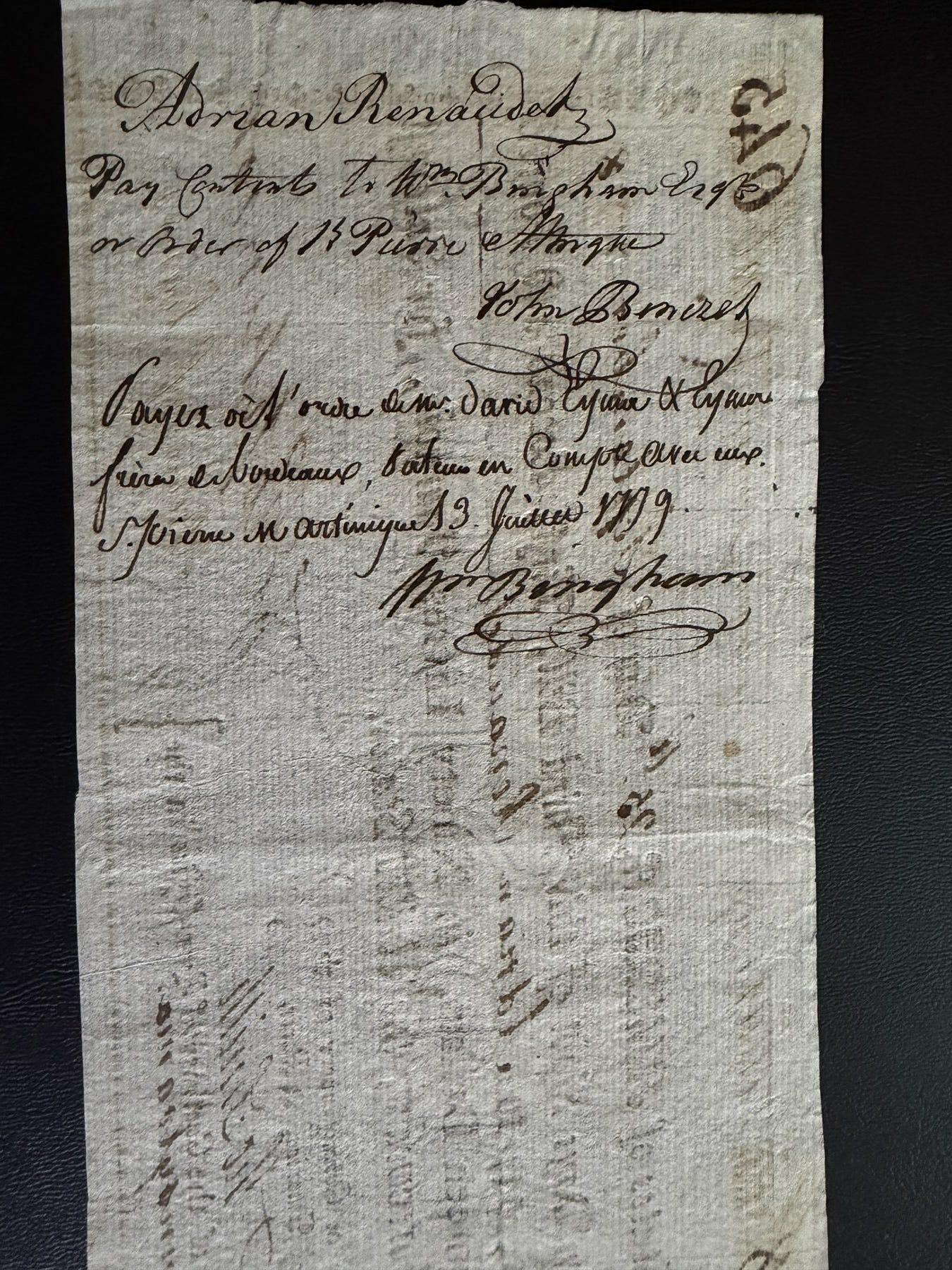
At magnification, the letter I had read as an l is not an l.
I established this the way an amateur does, which is to say by writing the name out both ways myself, over and over, until I could feel the difference in my own hand. An l is a loop. The pen goes up, curves over at the top, and comes back down the other side, and that curve is unmistakable once you know to look for it. This letter does not curve at the top. It comes to a point, and the stroke reverses there rather than turning — which is what a t does, and what only a t does.
There is no crossbar. That worried me for about a minute, until I understood that it is the least reliable feature of the letter: the bar is a separate stroke, made after the fact, and a hand in a hurry simply never goes back for it.
(There is a faint horizontal running through the name, and I want to be honest that I wanted it to be the crossbar. It is not. It is the clerk’s ruled fill-line, and it runs the whole width of the field, straight through the letters on either side.)
Then I looked at the face of the bill again — the line where the office wrote the payee in when it drew the thing. A point there too.
So the name is spelled with a t in every place it appears: on the face of the bill, on the reverse in the payee’s own hand, and in the issuing office’s register. Three attestations, and not one of them says otherwise.
And the one that governs is the middle one. The clerk in Philadelphia and the clerk who kept the register were both writing about a man. On the back of the bill, the man is writing his own name.
There was never an Adrian Renaudel. There was only my reading of one.
I have spent a year on the wrong letter — and it was never in the document. It was in me.
I do not have a good excuse. I have a partial one, which is that I was looking at a hurried eighteenth-century terminal letter under ordinary light and I saw what I expected to see. But the honest version is simpler than that. I read it once, wrote it down, and then never went back and checked it against anything, because it had become the thing I was searching for rather than the thing I had read. A year of dead ends is exactly the result that ought to have sent me back to the source, and instead it sent me to more indexes.
The name is Renaudet, and it always was.
I still do not know who he was. I want to be careful here, because there is a version of this essay where I tell you I have found him, and it would not be true. The register gives me a name spelled correctly and nothing else about the man — no age, no address, no occupation, no trade. Those are answerable questions and they are not answered yet, and I would rather leave the sentence unfinished in public than close it early.
And the ledger is thick
Here is what I keep coming back to.
Line 645 is one line.
Above it and below it, and on every opening I had time to photograph, the entries keep coming — other numbers, other dates, other names. Bills drawn by a commissioner in Connecticut, by another in Massachusetts, by another in Rhode Island. Somebody for sixty dollars, somebody for a hundred and twenty. Names I have never seen and have no reason to look for, each one attached to a person who took an interest-bearing promise from a government that had declared itself two years earlier and might not last three, and then went to a loan office to turn part of that promise into money in Paris.
I photographed a handful of openings. I did not get near the end of the book.
I went to Philadelphia to find one line. What was actually on the desk was a book full of them.
Every surviving loan office bill in a private collection anywhere — and there are more of them than people think, changing hands as signatures rather than as records — is one line in a ledger like this one. Detached, they are autographs of Francis Hopkinson. Put back against the register, they are transactions again, with a date and a counterparty and a place in a sequence.
I am not going to pretend I have worked out what that means to anybody but me. But I know the difference between a piece of paper you own and a piece of paper you can locate, and last Thursday my bill crossed from one to the other, in a reading room, in a volume that no search box will show you.
I am sorry about the noise.
The clerk wrote the name correctly in 1778. It took me until last week to read it.
Next week: the sheet of paper that actually did the work last Thursday was not the pull list. It was a paragraph of plain description handed across a desk, and I want to write about why that worked when a properly constructed research plan did not. Thanks for reading.
— Paul