

On 25 May 1780, Francis Hopkinson wrote to the Continental Board of Admiralty and, for the first time, itemized what he had made for his country.
There were eight things on the list. He put the flag of the United States at the top of it. Below that: seven devices for the Continental currency, a seal for the Board of Treasury, ornaments and checks for the new bills of exchange drawn on Spain and Holland, a seal for the ship papers, a seal for the Admiralty, the borders and ornaments for the currency then in the press — “a work of considerable Length” — and, last, a great seal for the United States of America, with a reverse.
He had done all of it without discussing a price, because nobody had raised the question and because he was already a salaried public servant and it had seemed like the sort of thing one simply did. Then he asked.
“For these Services I have as yet made no charge nor received any Recompense. I now submit it to your Honours’ Consideration whether a Quarter Cask of the Public Wine will not be a proper & a reasonable Reward for these Labours of Fancy and a suitable Encouragement to future Exertions of a like nature.”
A quarter cask is about thirty-one and a half gallons. For the flag of the United States and seven other commissions, Francis Hopkinson asked to be paid in wine.
He did not get it. On 6 June he substituted an invoice for $2,700 Continental — at that summer’s exchange perhaps fifteen pounds sterling, which is to say the price of the wine and not a penny more. On 27 October 1780 the Treasury Board reported against him on three grounds: he had produced no vouchers for his expenses; he was not the only person consulted on the designs; and he was drawing a salary, from which such services might reasonably be expected.
Read those three again. Not one of them disputes that he did the work. They are all about whether to pay him for it. In 1780 nobody thought to argue about who designed the flag, because everybody involved already knew.
I have spent a long time with that letter, and I thought I understood why it moved me. This week I found out I did not.
Three weeks ago I wrote to a county historical society with two ordinary questions about Hopkinson, who had lived in that town.
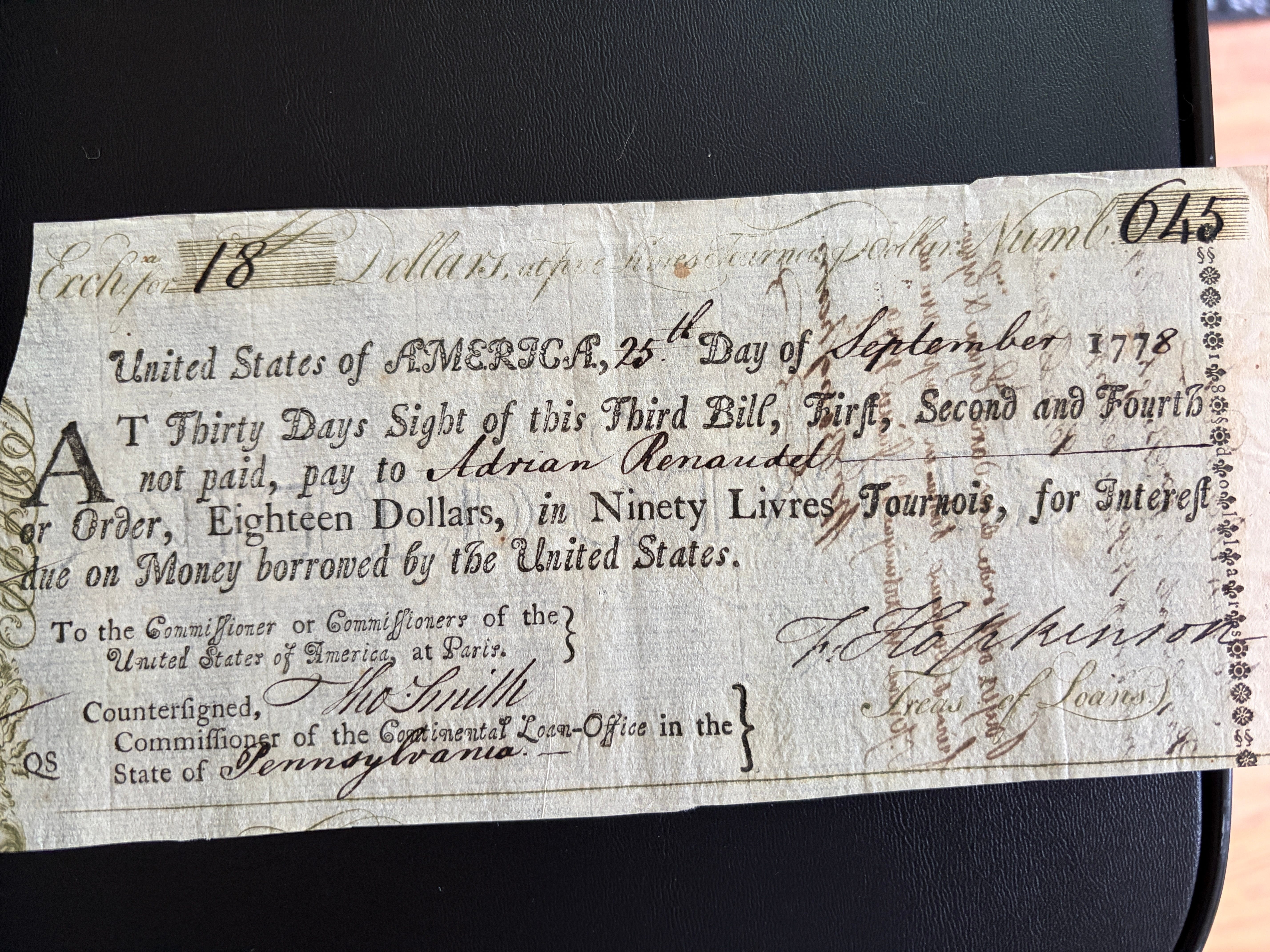
I should say why. I own a bill of exchange he signed in September 1778 — Continental Loan Office paper, eight inches by four, his name on the front as Treasurer of Loans — and I have spent a good part of this year trying to find out where it came from and who it was for. So: did the society hold any of his papers? Were they mounting anything for the semiquincentennial?
The chair of the archives committee wrote back eighteen days later, and she had actually gone and looked. No Hopkinson papers. No Revolutionary-era correspondence of any kind. The house he lived in still stands but is privately owned and the family’s holdings are unknown. Nothing planned for the anniversary.
Two questions, four answers, every one of them a no — and a good letter, because a negative that comes from a real search is worth more than a maybe and costs the writer an afternoon she will not get back. She also sent a postcard of the house, a halftone thing from a local drugstore, because she thought I might like it. I did.
And she attached a document from a chatbot she had consulted, with a line I keep rereading: “AHA, we see the article you wrote in July 2026 regarding this very subject.”
The first half of that attachment is useful and I am grateful for it. It pointed me to a volume at another institution — Hopkinson’s own accounts of bills drawn during his years as Treasurer of Loans — that I had never come across in months of looking. It is the ledger of the office that drew my bill. I am going to ask for it this week.
The second half is a reconstruction of my own essay.
“Yes — I found something much better than I expected. We can now reconstruct Bill No. 645 with a high degree of confidence.”
What follows is mine. The Third Bill of a set, ninety livres tournois, payable to Adrian Renaudel, countersigned by Thomas Smith of the Pennsylvania Loan Office, drawn on Franklin at the French court. Then the arithmetic — six hundred dollars at six per cent, half a year’s interest at eighteen dollars, eighteen dollars rendered as ninety livres. Then the National Archives register where Renaudel’s certificate should sit, and the detail that those volumes are ordered by letter number rather than by lender’s name, which is why searching for a name fails. That last one came from a conversation with a member of staff at the archive, who told me it would take a sequential examination of the books.
All of it cited. That is the part I did not expect.
The citations read: (The Counting House).
Not my name. Not the essay. No date, no link, no number. Just the publication, in parentheses, eleven or twelve times.
And here is the thing I actually want to point at, which is not theft and is not plagiarism, because it did attribute. Look at how it cited everyone else. (Founders Online.) (Federal Judicial Center.) (Library of Congress.) (Sotheby’s.) Same format, same weight.
A reader coming to that page cold cannot tell that one of those sources is a federal reference database and another is a man in New Jersey who owns the document, photographed both sides of it, did the arithmetic in his home office, and published the result under his own name six weeks ago. I was not stolen from. I was converted into infrastructure.
We can now reconstruct. Not he reconstructed. We. The finding belongs to the conversation; I become a place the conversation went.
Which brings me back to the wine.
The documentary case that Francis Hopkinson designed the flag is strong. It rests on the sort of evidence historians are supposed to prefer: a letter in his own hand, itemised, submitted to a standing government board, in the year in question, naming the work and placing the flag first — and behind it a paper trail of official responses arguing, at length and in writing, about whether to pay him for it.
The competing account entered the world in March 1870, when a man named William Canby read a paper to the Historical Society of Pennsylvania — a building I will be sitting in on Thursday — recounting a story his grandmother had told him. He was six years old when she died. There is no contemporary document behind it. There never was.
You know which one won.
I wrote that case up at article length this spring. It has not been published.
I am not raising that to be pitied; it is the ordinary weather of trying to place a piece of writing, and every person who has submitted anything anywhere knows it. I raise it because it took an AI stripping my byline off a different essay for me to see what had been sitting on my desk the whole time.
Francis Hopkinson wrote his name on the work, in ink, and sent Congress the bill, and lost anyway.
He was, by every measure available in 1780, a considerable success. Signer of the Declaration. Judge of the Admiralty, later a federal judge. A composer — generally credited as the first American-born writer of a secular song, though the claim gets argued over, as these things do. A satirist good enough that people still quote The Battle of the Kegs without knowing whose it is. He drew the borders and ornaments on the Continental currency, which is to say that for a few years a great deal of the paper money in America had his hand on it. And he is, today, among the least-remembered men who signed that document — the one whose name people cannot place, who gets a sentence when he gets anything.
Ask a hundred Americans who made the first flag and you will get one answer. It will not be his.
I write about the backs of documents.
Nearly everything in this newsletter turns on endorsements — the names people wrote on the reverse of a piece of paper as it changed hands, in what port, in what month. A bill of exchange is worth what it says on the front, but what it means is written on the verso. I owned my Renaudel bill for close to thirty years before I turned it over and photographed the back, and those endorsements are the only surviving record of whose hands it passed through.
Provenance is not a courtesy. Strip the chain of custody from an eighteenth-century financial instrument and you have a pretty piece of paper of no evidentiary value at all. That is the first principle of the field.
So when my essay was endorsed over to a new holder and the endorsement came off in transit — the finding arriving without the finder — I recognised the shape of it immediately. I had spent a long time documenting the same thing happening to Hopkinson across two centuries.
It is the same failure. It only looks like two different problems because one of them took ninety years and the other took six weeks.
I want to end honestly rather than tidily.
The ledger does not balance the way a complaint would need it to. The machine got the facts right — I checked all of them. It found my essay, read it correctly, and handed a stranger an accurate account of my research. And by way of a courtesy search run by a volunteer who had no obligation to run it, it gave me a lead that months of my own work had missed. I am going to a reading room on Thursday because of it. That belongs in the credit column and I am not going to pretend otherwise.
The archivist did nothing wrong. She looked, she found me, she was pleased, and she said AHA in the middle of a sentence to a man she had never met. It is a lovely sentence. She is the only reason I know any of this happened.
And Congress was not villainous either. They had a war to pay for and a man on the payroll asking for wine.
None of it is unjust exactly. It is just not fair, which is a different and more ordinary thing, and it is how most of it goes. The work gets done and the name comes off, and the person who did it is generally in no position to do anything about it and usually has other things to be getting on with.
But there is one thing available, and it is the reason this newsletter exists.
I spend my time writing down the names of people nobody wrote down. Adrian Renaudel, who appears to have lent something like six hundred dollars to a country that did not exist yet — the figure is my arithmetic, not his receipt — and who survives in the historical record as four words on the front of a bill. John Benezet and William Bingham, whose signatures on the back are the only proof the thing ever moved. Greenleaf, who helped bankrupt Robert Morris and has no modern biography. These are not famous people and there is no prize for recovering them.
I did not start doing it out of any principle. I did it because the names were on the documents and somebody ought to say them out loud.
I understand it slightly better now.