

For about twenty years I owned a piece of paper without knowing what it was. It sat in an unmarked envelope in a file, undisturbed, through two house moves and one career. I did not research it. I did not photograph it. I am not sure I could have told you, three weeks ago, what was written on it.
Two weeks ago I took it out.
This is the fifteenth in a series. I buy old financial paper, and then I find out what it is. The rule is that I print what I find, even when it isn’t what I went looking for — and this is one of those.
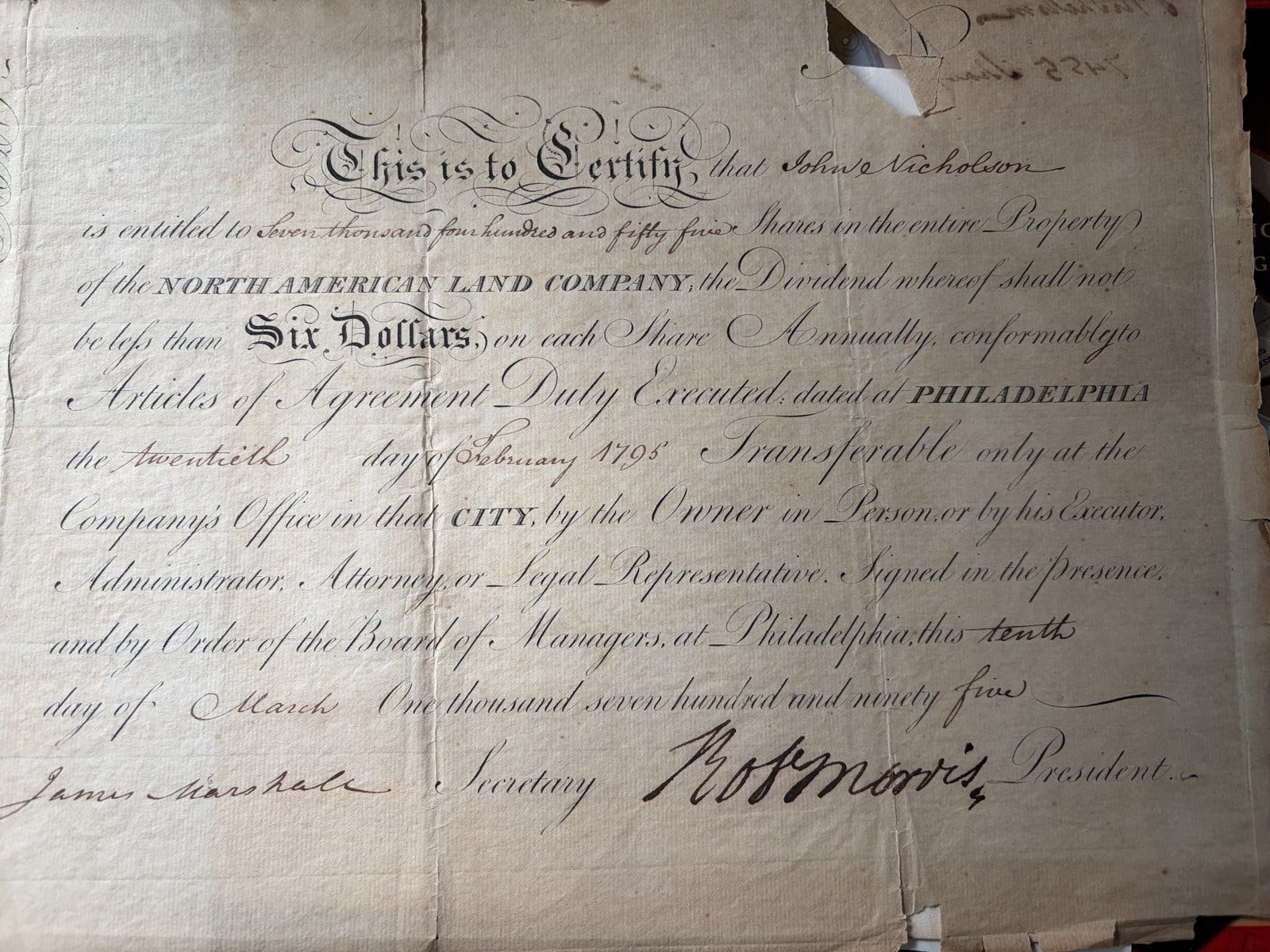
It is a share certificate of the North American Land Company, printed and filled in by hand, dated at Philadelphia the tenth day of March 1795. It is signed at the bottom by Robert Morris, as President — the man who financed the Revolution, Superintendent of Finance, signer of the Declaration, the Articles and the Constitution. Beside him, James Marshall, as Secretary. It certifies that John Nicholson is entitled to seven thousand four hundred and fifty-five shares.
The arithmetic on the front
The North American Land Company was organised in February 1795 by three men: Robert Morris, John Nicholson, and James Greenleaf. Between them they had assembled something on the order of six million acres of unimproved land — in Pennsylvania, Virginia, North Carolina, South Carolina, Georgia and Kentucky — bought at a few cents an acre, and they proposed to sell it to the public in shares.
The capital was divided into 30,000 shares of $100 each. The certificate promises that the dividend “shall not be less than Six Dollars on each Share Annually” — a guaranteed six percent, printed in the largest type on the page, and the reason anyone would buy in at all.
So the numbers on my sheet:
7,455 shares out of 30,000 — 24.85 percent of the entire company
$745,500 at par
$44,730 a year, guaranteed, in 1795 dollars
Issued eighteen days after the Articles of Agreement were executed
This is not an investor’s parcel. It is a founder’s block, issued to one founder, signed by another, eighteen days after they formed the company. A quarter of the whole enterprise, on one sheet of paper.
The guaranteed dividend was never paid.
The company collapsed in 1798. Morris was arrested for debt and taken to the debtors’ prison on Prune Street in Philadelphia, where he stayed from February 1798 until August 1801. Nicholson followed him into the same prison. He did not come out. He died there on 5 December 1800, leaving a wife, eight children, and debts of more than four million dollars.
Four million dollars, in 1800, owed by the man who signed the back of my certificate.
A brief note before I go further: I publish these primary-source essays on early-Republic financial history weekly. If the format is your thing, a free subscription gets each one delivered by email as it comes out. It’s the easiest way to follow the project as it develops.
Turning it over
The front of the document is not a mystery. It is a printed form, beautifully engrossed, and it says exactly what it says.
The back is where I expected to find something.
I had two questions going in, and I want to report both, because both of them died.
The first was a number. On a first quick look at the endorsement I thought I read 7445 — ten shares short of the 7,455 written out on the front. A ten-share discrepancy between the face of a certificate and its own endorsement would be precisely the sort of small, checkable anomaly that turns into an essay. Clerk’s slip, partial transfer, correction, something.
Under better light it is 7455. The front and the back agree. There is no discrepancy. I had misread my own document.
The second was a hand. There is writing beneath the signature, and I could not make it out. The front of the certificate anticipates this exactly: the shares are “Transferable only at the Company’s Office in that CITY, by the Owner in Person, or by his Executor, Administrator, Attorney, or legal Representative.” If the line under the signature turned out to be an attorney’s attestation — someone signing on Nicholson’s behalf — then the paper would record not only a transfer but how it was executed, and by whom, at a moment when Nicholson’s affairs were beginning to come apart.
It is not an attestation. It reads “7455 Shares” — the same hand, the same ink, the same pen as the signature above it. Nicholson signed the back of his certificate and wrote down how many shares it was for.
Two questions, two dead ends. That is most of what research is, and I would rather print it than quietly leave it out.
Here is what is on the back
Then I looked at what was actually there, rather than at what I had hoped was there.
The verso of the certificate carries three things. A pencilled “322” in the upper right, which is modern — a dealer’s number or an inventory mark, not period. The show-through of the printed front, visible in the paper. And, in the upper left, in brown ink:
J Nicholson
7455 Shares
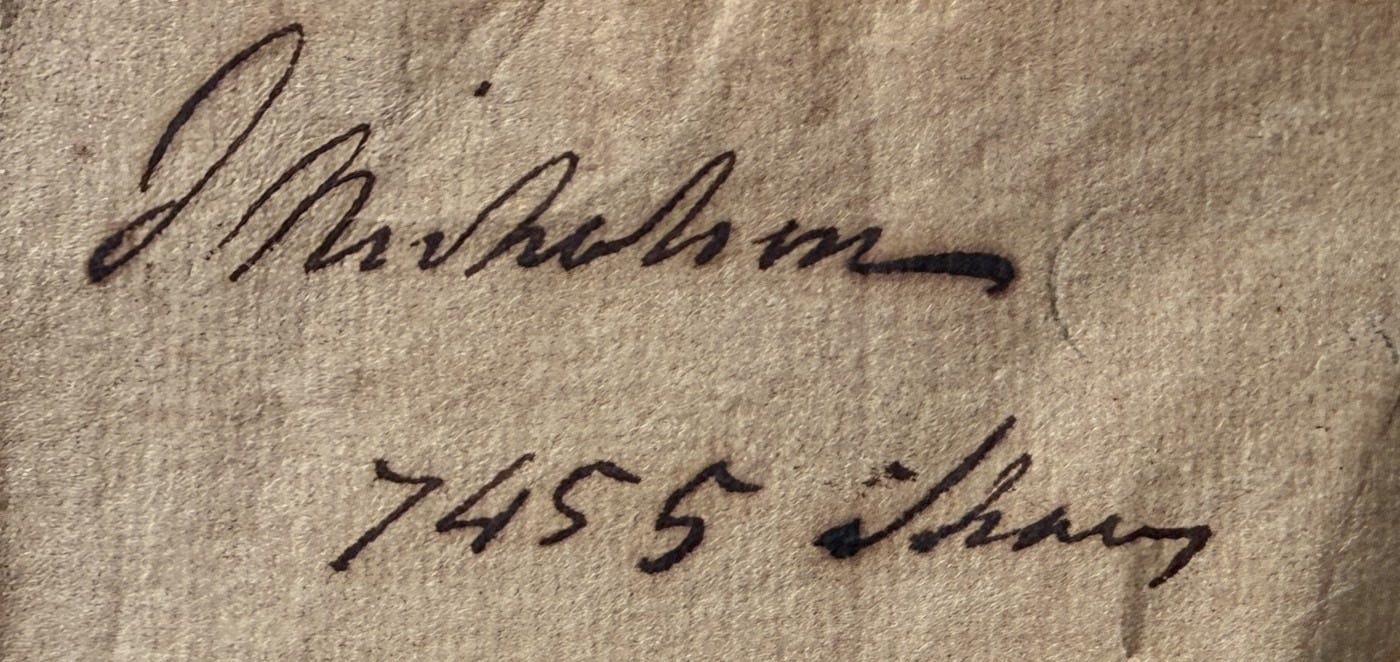
That is all. There is no date. There is no assignee. There is no name.
I went over the rest of the sheet twice. The lower half is blank apart from the front bleeding through. Nicholson signed the back of a certificate for a quarter of the North American Land Company, wrote the quantity underneath, and made it out to nobody at all.
What a blank signature does
An endorsement on the back of a financial instrument is not decoration. It is the mechanism of transfer, and it comes in two forms. A special endorsement names the person the instrument is passing to — pay to the order of so-and-so — and only that person can take it. A blank endorsement is just a signature. It converts the instrument into something transferable by delivery: whoever holds it, owns it.
I spend most of my time with bills of exchange, where this distinction is the whole game. The back of an eighteenth-century bill is often more informative than the front, because the front tells you what was promised and the back tells you where the promise travelled and through whose hands.
So a signature and a quantity, with no name, is a specific thing rather than an absence. And I can read it two ways, and I cannot yet tell you which is right.
It may be a transfer that was prepared and never completed. Nicholson signs, the deal falls through or is overtaken, and the certificate stays where it is. Between 1795 and 1798 a great deal was begun by these three men and not finished, and a signature waiting for a name it never got would be one more of those.
Or it may be deliberate. A certificate signed in blank can be handed to a creditor, pledged as security, passed along, without another word written on it. It becomes, in effect, a bearer instrument for a quarter of a company. That would put this sheet in the middle of the collateralizing that preceded the collapse — the period in which the same assets were pledged over and over, and nobody could afterwards establish who held what.
The front of the certificate insists that transfer happens at the Company’s Office, in person or by attorney. The back does not look like that. It looks like paper being moved the fast way.
I don’t know which it is. That is a question with a documentary answer, and the answer is somewhere in the company’s own records.
Where the answer would be
The North American Land Company Records are at the Historical Society of Pennsylvania, Collection #1432.
That is the collection in which the meaning of a completely different document of mine was found this spring — a bank order Aaron Burr wrote in New York on 27 July 1796, for five thousand dollars, which I had owned since 1992 and which is now in HSP’s custody. When they accepted it, they said the reason was its “strong relationship to our North American Land Company records.”
I bought the Burr order in 1992. I bought the Morris certificate around 2006, and put it in an envelope, and forgot about it. Fourteen years apart, no thesis, no plan — and I did not know until this month that they belonged to the same story.
And in the middle of both of them, again, is James Greenleaf. Third partner of the North American Land Company. The man whose agency accounts explained the Burr order. The name I thought I was finished with in June.
I want to be careful here, because this is the point where a good find starts writing cheques the evidence cannot cash. The North American Land Company was enormous and its paper is not rare; two documents touching the same famous collapse is not destiny, and I am not going to write it that way. Morris has a modern biography. Nicholson has a scholarship. Greenleaf, so far as I can find, has neither.
Two objects came into my hands fourteen years apart, bought for different reasons, and they turn out to route through the same man — and he is the one nobody has written about. I did not go looking for that. I am still deciding what it means, and I would rather say so than pretend I already know.
For now there is a sheet of paper on my desk that is one quarter of the company that ruined the man who financed the American Revolution. It spent twenty years in an unmarked envelope in my own house, and I never once turned it over.
It is signed on the back, in Nicholson’s hand, and made out to no one.
Next Wednesday: the backs of things. I’ll put this certificate beside a 1778 bill of exchange I own that William Bingham endorsed at St. Pierre, Martinique, in 1779, and work through what an eighteenth-century endorsement actually did — why the reverse of a financial instrument is so often the more informative side, and what it means when the name is left off.
And in the near future I’m planning to explore the Historical Society of Pennsylvania’s own catalogue for the North American Land Company — two full drawers of Robert Morris cards that, as far as I can tell, nobody has read through. If the company’s records say where this certificate was meant to go, that is where it will be.
Thanks for reading.
— Paul