

[Update 2026-07-22: A week after publishing this essay, I photographed the back of the bill for the first time. It is endorsed twice — by Adrian Renaudel himself, and by William Bingham, the Continental Congress's Agent at Martinique. A follow-up piece with what I found is here: paulgmole.substack.com/p/turning-it-over. Everything below is preserved as originally written.]
There is a document at the National Archives that I have been trying to trace for a year, and last month I finally sent an official inquiry to the archivists at College Park, Maryland asking whether they could find it.
The archivists at NARA are excellent. Their answer was: probably, but not for you.
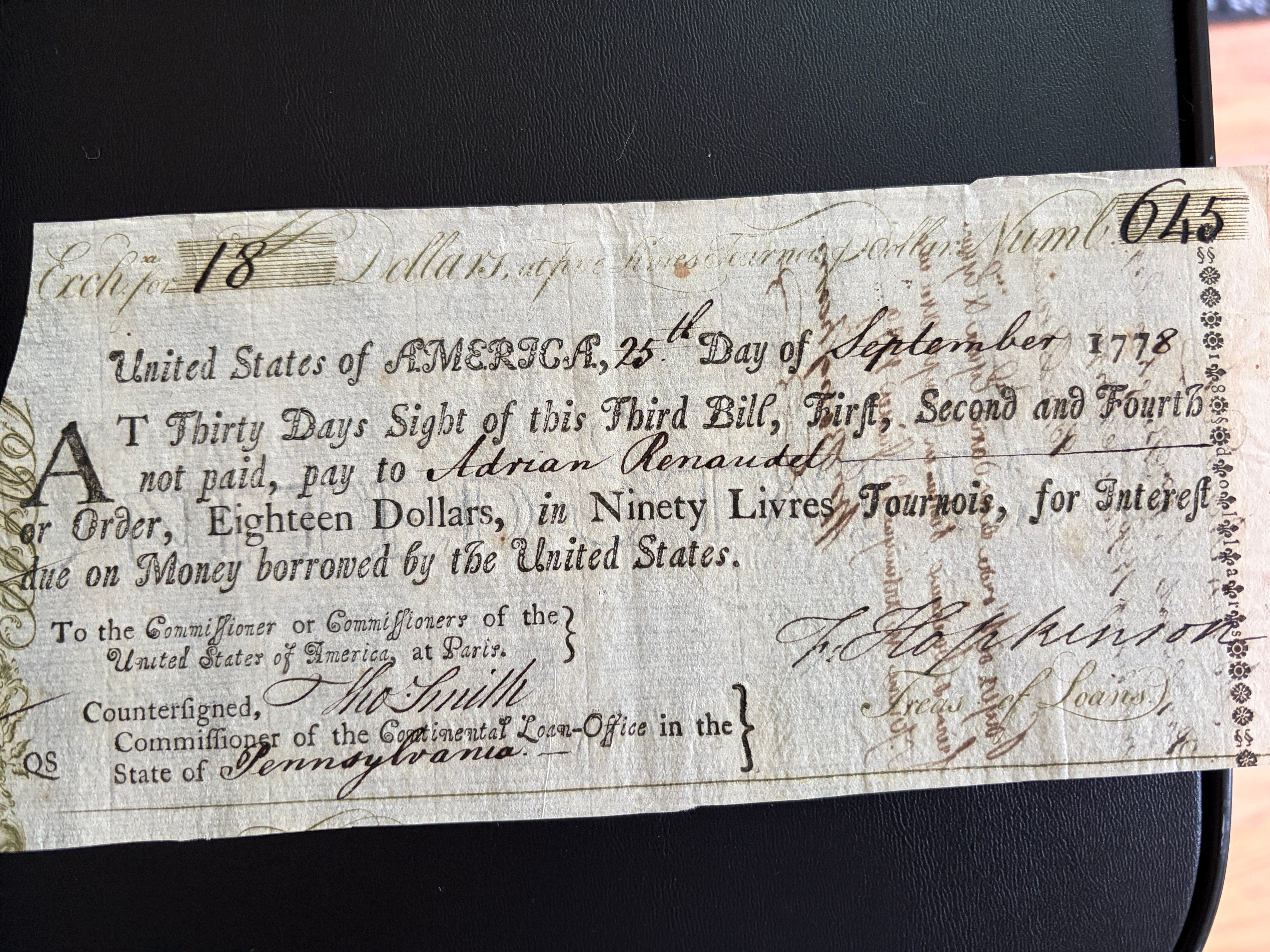
This is a piece about that answer, and about the document I was trying to trace — a 1778 bill of exchange signed by Francis Hopkinson and drawn on Benjamin Franklin in Paris.
It continues a run of essays I’m publishing on the primary-source financial history of the founding period. The one before it, in late June, was about a check Aaron Burr wrote in 1796 that ended up at the Historical Society of Pennsylvania. This one is about a document I still have — a bill of exchange made out to a French national named Adrian Renaudel for ninety livres tournois, or eighteen American dollars — and about the answer the National Archives gave me when I asked for its underlying record. It is one of thousands like it that were issued during the Revolutionary War, and it is a document most Americans have never heard of and most historians rarely write about.
The bill itself is small: about eight inches by four, printed in ornamented copperplate in Philadelphia and filled in by hand. At the top: Bill of Exchange No. 645. On the second line: Third Bill. Below, in a clean secretary hand:
Pay to the said Adrian Renaudel or order the sum of ninety livres tournois, being the amount of one half-year’s interest on money borrowed by the United States, for value received, having advised the Honorable Benjamin Franklin, Esquire, Commissioner from the United States of America to the Court of France, thereof.
The signatures are two. In the lower right, in Hopkinson’s characteristic small-letter hand: Fran. Hopkinson, Treasurer of Loans. To the left, more formal: Tho. Smith, Commissioner Continental Loan Office, State of Pennsylvania. A date, in the middle: 25 September 1778.
The document is authenticated. It is genuine. What it says, and what it did, and what happened to the man whose name is written across it, is a story I have been trying to piece together.
The Continental Congress had a money problem from the beginning. Wars are expensive. In 1775 there was no federal government, no unified currency, no tax authority, no treasury. The paper money the Congress printed — the Continental dollar — began depreciating almost immediately, and by 1778 it was worth roughly one-fortieth of its face value in specie. If you had gold or silver, or if you held sterling, you did not want Continentals in exchange for anything.
The solution the Congress landed on in 1776 was the loan office. Each of the thirteen states would host a Continental Loan Office run by a state-level Commissioner. Citizens — American or foreign — could lend money to the United States by purchasing a loan certificate at that office. The certificate paid six percent interest, semi-annually. What made the loan office system work, however, was not the six percent. It was the currency in which the interest was paid.
The Congress did not have the specie to pay interest to lenders in hard currency, and lenders did not want to be paid in the depreciating Continental. So the Congress arranged something clever. Interest on loan certificates would be paid via bills of exchange, drawn on the American commissioner in France — Benjamin Franklin — payable at Passy, Franklin’s residence outside Paris, in French livres tournois. A lender in Philadelphia would surrender a small piece of paper — a bill of exchange signed by the Treasurer of Loans in Philadelphia and countersigned by the state commissioner — and if that piece of paper made its way to Paris ahead of the two other identical bills (each numbered the same, distinguished only as First Bill, Second Bill, Third Bill, since transatlantic mail was chancy and redundancy was survival), it was payable in hard French currency at the standing American diplomatic residence.
A brief note before I go further: I publish these primary-source essays on early-Republic financial history weekly. If the format is your thing, a free subscription gets each one delivered by email as it comes out. It’s the easiest way to follow the project as it develops.
This is what my document is. A Third Bill. One of three identical instruments sent by three different vessels in 1778 to make sure at least one reached Paris, drawn on Franklin, payable to Adrian Renaudel, for ninety livres tournois — the six-month interest at six percent on the certificate Renaudel had purchased. Renaudel had lent the United States roughly three thousand livres tournois, or approximately six hundred American dollars at the day’s rate. His interest for the half year was ninety livres. Paid in hard French currency at Franklin’s residence. Not in the paper the Continental Congress was printing, which was worth less every month.
Who was Adrian Renaudel? This is where the archives stop being cooperative.
I know he was a French national. The name is French, the payment convention is French, and Americans who lent to the loan offices were paid in Continental dollars, not livres tournois — the livres-payable arrangement was specifically structured for foreign nationals, and most likely French. I know he had approximately six hundred dollars of capital available to lend to a war effort in a country not yet allied with his, in September of 1777 or March of 1778 (six months before the interest payment of September 1778). I know he was either in America directly, or represented in America by a merchant who purchased the certificate on his behalf and shipped him the bills of exchange.
I do not know his profession, his age, where in France he was from, whether he was a merchant or a rentier or a naval officer or a supplier of gunpowder. I do not know when he was born or when he died. I do not know what became of his loan certificate — whether it was ever redeemed, whether it was inherited, whether it was lost in one of the Continental-currency devaluations. I do not know whether Renaudel ever received his ninety livres.
The last question is the one I most wanted to answer. Because if the Third Bill I hold was never presented for payment — if the First Bill or Second Bill arrived at Paris first, honored, and this Third one was never redeemed — then the very fact of the paper’s survival is a small mystery. Bills that were paid were typically stamped, endorsed, and destroyed. Bills that were never paid tended to survive longer, because someone was keeping them in case they might one day be honored, until eventually they became collectible curios. My Third Bill has no cancellation marks. It looks, to a naive eye, unpaid.
The Register of Pennsylvania Loan Certificates, 1776-1781, is at the National Archives in College Park, Maryland. NAID 1627457, held under NC-120 accession numbers 219, 220, and 221. It is where the underlying certificate that generated this bill — Renaudel’s original loan-office document — would have been recorded. Twenty months of research had persuaded me that if I could find the certificate entry, I could learn Renaudel’s amount, his date of purchase, possibly his address, possibly which state office he lent through, and possibly whether it was ever redeemed. All of the story is there. But it is bound in leather volumes and it is not indexed by name.
Tom McAnear, the archivist at NARA who eventually took my inquiry, wrote back after his team had physically opened the boxes and looked at the volumes. His answer, condensed: the records are indexed by “letter number” — the number assigned when a piece of correspondence was received at the office, in chronological order of receipt, without regard to who the person was or what the amount was. To find Adrian Renaudel in this system, you would need to page through several volumes sequentially, watching for his name to appear. The archivists at NARA are staffed for research inquiries at approximately one hour per request. Locating Renaudel by sequential scan would take, in Mr. McAnear’s honest and generous estimate, “the better of a day, or more.”
You are welcome to come to College Park and search the volumes yourself, he wrote. Or you can hire a professional researcher from our list.
I am, honestly, not going to make the trip and not going to hire a researcher — not for this document, at this stage, on this budget. The finding I most wanted — Renaudel’s precise identity and the disposition of his loan — is going to remain unfound. The Third Bill remains, in this respect, a mystery I cannot fully close.
There is something that has stayed with me about the whole exchange, however, and it is the reason I am writing about it now instead of quietly moving on.
The historians who write the Revolution — I mean the popular historians, the ones people actually read — describe the financing of the war as a story about Robert Morris and paper currency and the eventual establishment of the Bank of North America. There is a supporting cast: Franklin negotiating French loans; Hamilton later consolidating the debt; the Congress’s chronic desperation. What is almost never told is how it worked at the level of the individual foreign lender. Adrian Renaudel — whoever he actually was — put six hundred dollars of his money into an unproven revolutionary project in a country where the outcome was very much still in doubt, in exchange for a piece of paper printed in Philadelphia that promised him small semi-annual payments in French currency at the American diplomatic residence in Paris. That is a specific act of faith by a specific person, whose name we have and whose story is otherwise gone.
Multiply him by thousands. There were tens of thousands of loan certificates issued between 1776 and 1781 across the thirteen state loan offices. Each one represents a specific bet by a specific person. Some of them were paid, and some were not. Some of the lenders became wealthy, and some were ruined. The paper survives, when it survives, at random — in family papers, in leather-bound archive volumes, occasionally in the drawer of a New Hampshire autograph dealer where I once found a Burr check. Almost all of the individual stories are gone.
There is a way of thinking about the founding of the country that treats it as a set of political propositions — self-government, natural rights, the sovereignty of the people. That framing is not wrong. But there is another framing, less discussed, in which the founding was also a specific financial arrangement worked out at desks in Philadelphia and Passy and Baltimore and New York, between citizens and foreign nationals who had decided, individually, that this particular experiment was worth putting money into. When the political mythology gets thick — this is not a bad time for political mythology to get thick — I find it steadying to look at these small pieces of paper and think about the specific people whose names are written on them, and the specific bets they placed.
Adrian Renaudel put ninety livres tournois’ worth of interest at risk with the United States of America in September 1778. Whether he ever collected on that piece of paper is a question the archives have not chosen to answer.
The document is on my desk. It is not going anywhere.
Ninety livres tournois.
— Paul
Next week: I want to write about what happened to the value of a Continental dollar between 1778 and 1780, and why the story historians tell about it is missing an important character.
Thank you for reading.