

A Patriot, a Loyalist, and a London Banker Walk Into a Document
Before the Storm — Post 2 of 5
In August 1765, three men put their names on a piece of paper. None of them, as far as I can tell, thought they were doing anything remarkable. They were conducting business. Commerce was the texture of daily life in the Atlantic world of the eighteenth century — the bills of exchange and factor accounts and timber consignments that moved money and goods across three thousand miles of ocean. Document 106 in a routine series was a receipt. A settlement. A bookkeeping entry made physical.
What makes it extraordinary is what happened next to each of the men who signed it.
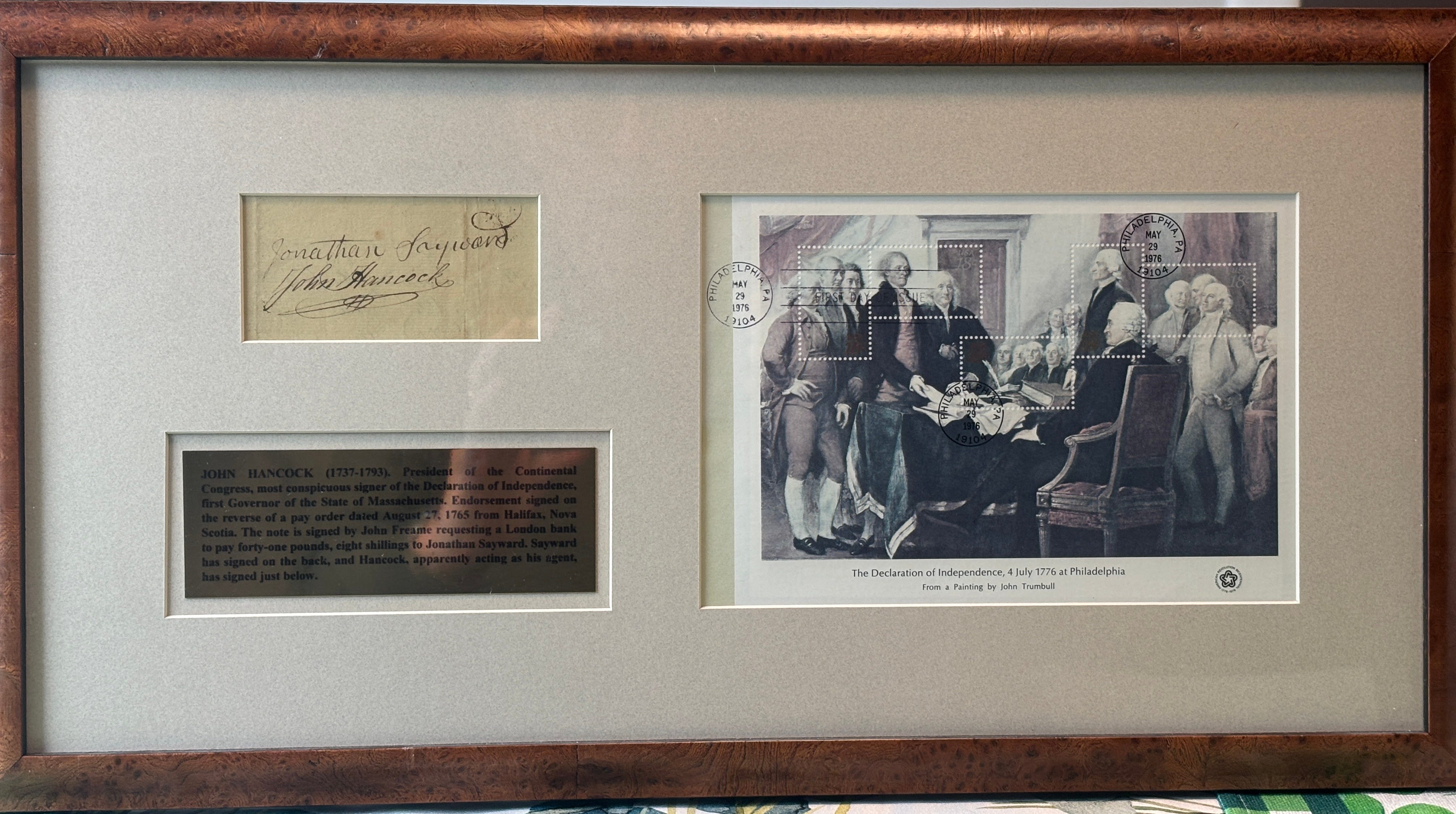
The document as it hung on my wall for twenty-eight years — Jonathan Sayward and John Hancock signatures visible through the frame, the Freame signature hidden beneath the mat.
John Hancock: The Patriot Who Hadn’t Become One Yet
Let me be direct about something: in August 1765, John Hancock (1737–1793) was not yet a revolutionary. He was a merchant.
He had inherited from his uncle Thomas in 1764 one of the largest mercantile houses in New England — trading in whale oil, timber, naval stores, and imported British manufactured goods, with connections to London, the West Indies, and the Atlantic seaboard. He was already one of the wealthiest men in Massachusetts. He was commercially prominent, politically connected, and thoroughly embedded in the imperial trading system that he would, within a few years, help to dismantle.
His endorsement on the back of my document — on the verso, in the language of bill-of-exchange practice — indicates that he was acting as what contemporaries called a factor: a Boston intermediary who arranged Sayward’s consignments, directed them through London banking contacts, and whose signature on the back of the resulting payment draft certified the transaction chain from Halifax to Lombard Street. He wasn’t the principal. He was the facilitator. He took a commission.
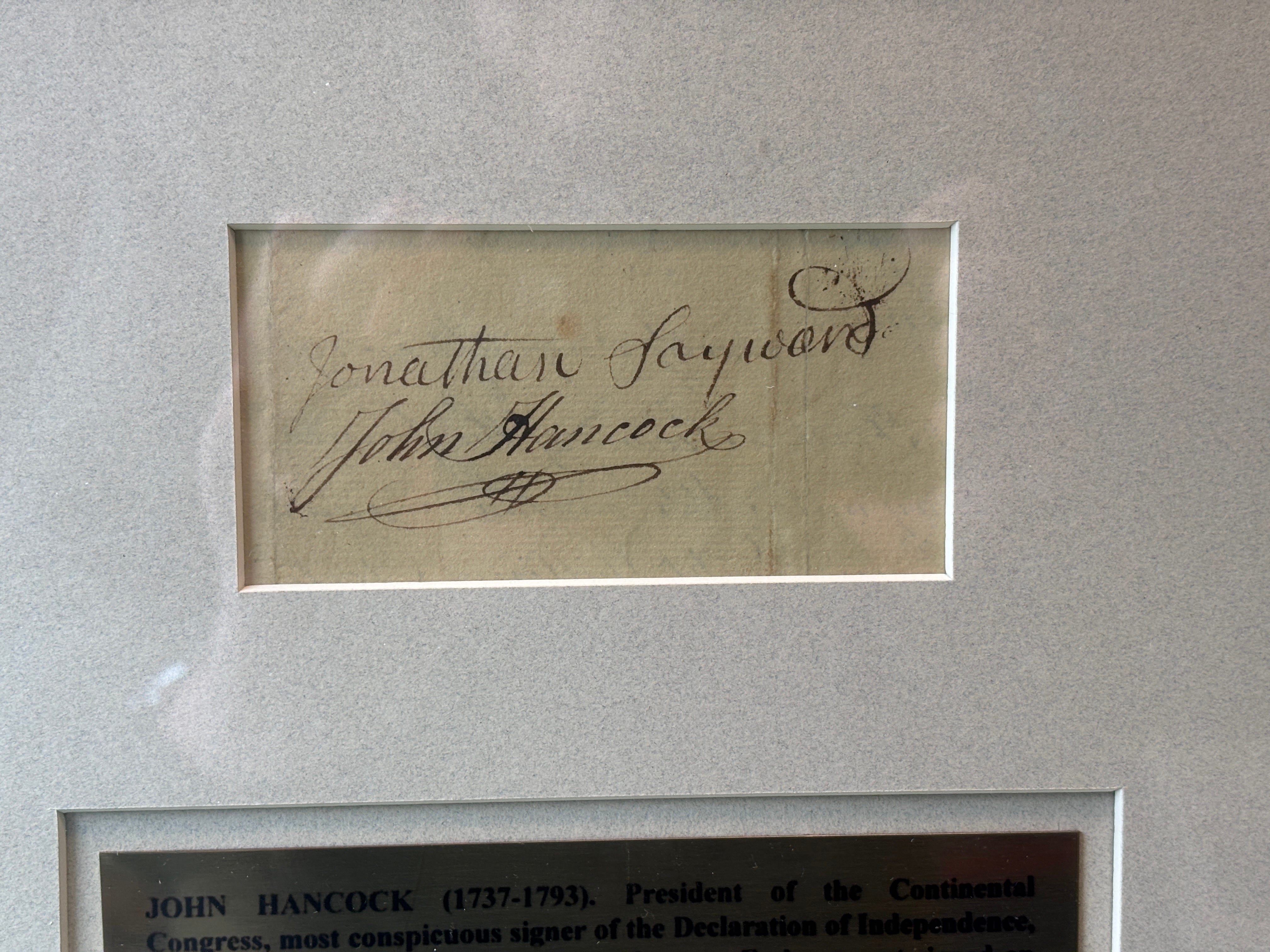
Close-up of the Sayward and Hancock signatures as seen through the original framing mat. Jonathan Sayward above, John Hancock below — both on the verso of the document.
This is not how we remember John Hancock. We remember the signature that sprawls across the center of the Declaration of Independence — the one bold enough, the legend says, for King George to read without his spectacles. We remember the President of the Continental Congress, the face of the patriot movement, the man who would become the first governor of Massachusetts.
But in August 1765, he was endorsing a bill of exchange for a Maine timber merchant whose goods moved through Halifax. Commerce first. Revolution later.
The irony deepens when you know what came after. Within three years, Hancock would sign the non-importation agreements that targeted exactly the kind of British trade this document represents. He would become one of the most visible leaders of the movement that made Jonathan Sayward’s world impossible, that made the commercial system this document inhabits a casualty of history.
In August 1765, he hadn’t started yet.
Jonathan Sayward: The Loyalist History Forgot
Jonathan Sayward (1713–1797) is the figure in this story who deserves the most attention, and gets the least.
He was, in August 1765, at the height of his power. Sixty-two years of disciplined commercial activity had made him the wealthiest merchant in York, Maine — a justice of the Court of Common Pleas, a representative to the Massachusetts General Court, a man who owned ships and mortgages and the respect of his community. The American Antiquarian Society’s finding aid describes him as someone who “rose from uneducated, working-class origins to assume social and political leadership” in his town. That is a steeper climb than most.
His commercial reach in August 1765 was considerable. The document that bears his name was drawn in Halifax, Nova Scotia — not York, not Boston, not London. Sayward was running an Atlantic trading operation that extended north into the British garrison economy of Nova Scotia as well as south along the New England coast. His diary for August 1765 records ships arriving from Halifax, consignments moving, money changing hands. The £41.8 Sterling named on my document represents the net settlement of one thread in a commercial web that spanned hundreds of miles of coastline.
His views on the coming Revolution were not those of a coward or a sycophant. They were the considered convictions of a man who had prospered within the imperial system and who believed — correctly, as it turned out — that confrontation with Parliament would bring ruin. He wrote in his diary, after the Stamp Act crisis: I was much against Resolutions being sent in a Public manner by authority. I then said it would bring the weight of ministerial vengeance on this province. I have lived to see my prediction fulfilled.
He was not wrong. He was simply on the side that history decided to condemn.
By 1768 he was voting to rescind the Massachusetts Circular Letter — the colonial protest against British taxation that Samuel Adams had circulated among the colonies. The ninety-two members of the General Court who voted against rescinding were celebrated; Paul Revere made them a silver Liberty Bowl, now one of the most famous objects in American decorative arts. The seventeen who voted for rescinding — Sayward among them — were condemned. Revere’s political cartoon A Warm Place — Hell showed them being driven into the inferno by the devil, with Sayward labeled “His E---y’s Chief Soothsayer and Grand Oracle of Infallibility.”
By 1775 he had lost everything. His offices, stripped. His ships, seized. His wife Sarah, dead. His diary for December 31, 1775 records, with a restraint that makes it more devastating, that he had “lost a new Sloop...and suffered the loss of one or more cargoes in West Indies...on account of my political sentiments and conduct.”
His house survives. The Sayward-Wheeler House in York Harbor, Maine — his home, preserved essentially unchanged from his occupancy — is today maintained by Historic New England as one of the finest surviving colonial interiors in the nation. His diaries, forty volumes of them, sit at the American Antiquarian Society. He is remembered, where he is remembered at all, as a cautionary tale. The man who chose wrong.
I have been thinking about Jonathan Sayward for several months now. I find that I cannot write him off as easily as history has.
John Freame: The Banker in Halifax
John Freame (1730–1770) is the least famous name on my document and arguably the most remarkable — and he is also the one whose full story I only learned after I removed the document from its frame.
For twenty-eight years, the mat covering the lower portion of the document face hid most of what he wrote. I knew his name was there — the original 1998 framing placard mentioned a John Freame — but I could not read his signature or the text surrounding it. When I had the document professionally unframed this month, the full face became readable for the first time.
What it revealed changed everything I thought I knew about where this document came from.
Freame did not sign from London. He signed from Halifax, Nova Scotia.
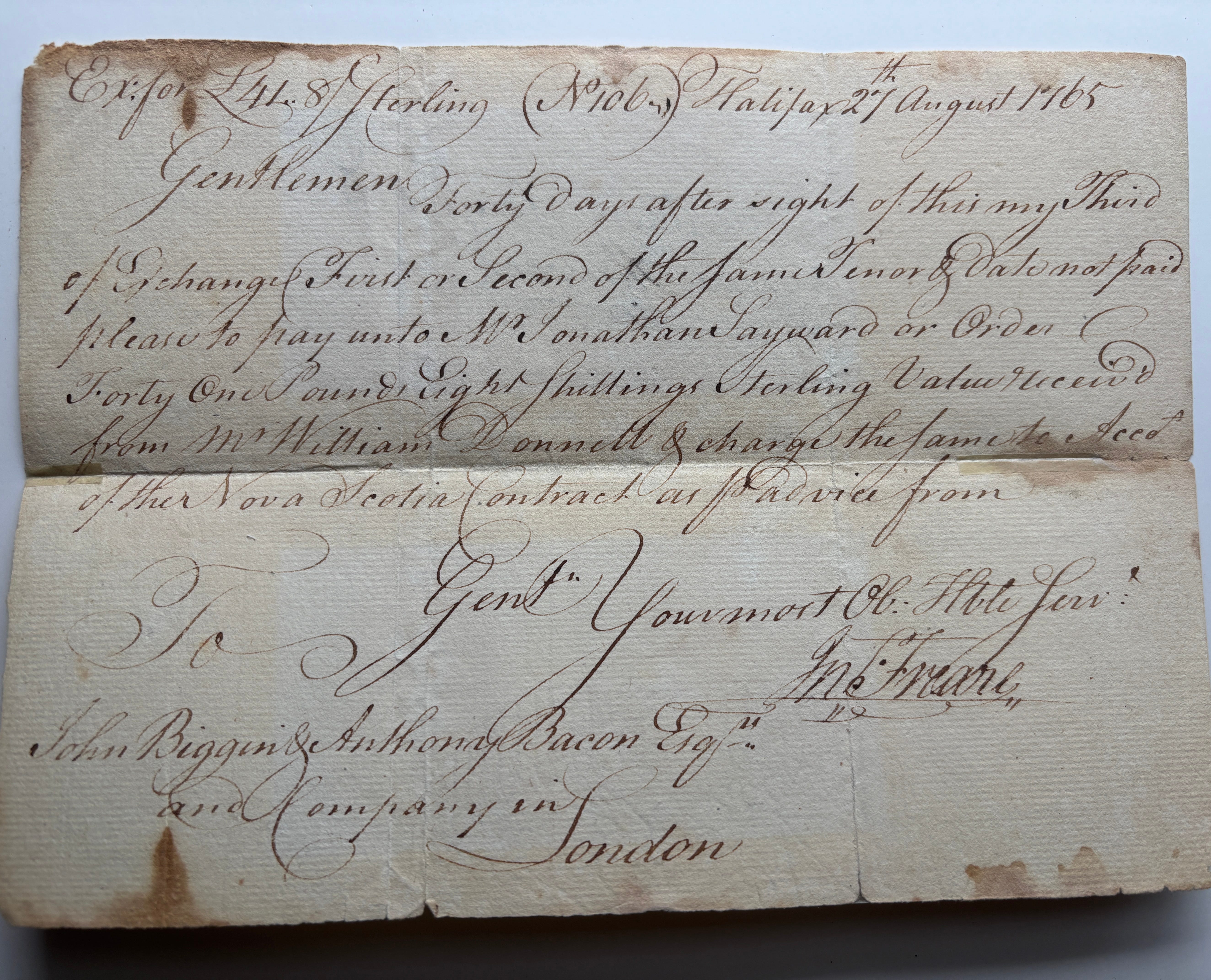
The full document face, unframed for the first time. The header reads clearly: Halifax 27th August 1765. The Freame signature — "Jno Freame" — is visible at center right. Addressed to John Biggin & Anthony Bacon Esqrs and Company in London.
The header reads clearly: Halifax 27th August 1765. Freame was physically present in Halifax — in the British garrison colony at the northeastern edge of the Atlantic seaboard — when he drew this bill of exchange. He directed a London firm, John Biggin and Anthony Bacon, to pay Jonathan Sayward £41.8 Sterling. The payment was charged to a Nova Scotia Contract, with value received from a man named William Donnell. The document is explicitly the “Third of Exchange” — the third copy in a set of three dispatched on different ships to ensure one survived the Atlantic crossing. It did.
This is not the London banker I had imagined. This is a Freame partner active in the field, managing the colonial end of the Atlantic commerce his family’s firm had financed for three generations.
His grandfather — also named John Freame — co-founded a goldsmith-banking partnership on Lombard Street in London in 1690, along with a man named Thomas Gould. They were Quakers, operating in a world where the Society of Friends provided both the trust network and the merchant clientele that made a banking operation viable. The firm financed Quaker merchants across the Atlantic — in Philadelphia, New York, Newport, the Caribbean — managing their London accounts, selling their consignments, issuing payment drafts. In 1736, a man named James Barclay married Freame’s daughter and entered the partnership. The name Barclay was now in the firm. In 1759, the younger John Freame joined as well, creating the three-name style: Freame, Barclay, and Freame.
John Freame (1730–1770) died five years after my document was drawn. He left no famous descendants, no celebrated career, no entry in the standard biographical dictionaries of the revolutionary era. He was a banker. He did his job — including, in August 1765, doing it in person in Halifax.
But the firm he was part of outlasted him by centuries. The Barclay interests grew and merged and acquired and expanded until, in 1896, they became a joint stock company called Barclays Bank Limited. Barclays Bank formally traces its institutional origins to the 1690 founding of that Freame-Gould partnership. The man who signed my document in Halifax was part of that founding family.
His signature now reads clearly: Jno Freame, preceded by the standard eighteenth-century closing Your most Ob: Hble Serv: — Your most Obedient Humble Servant. For twenty-eight years it sat behind a mat. I can read it now.
The Document They Share
Three men. Three trajectories. One piece of paper — drawn not in London, as I once thought, but in Halifax, Nova Scotia, at the northeastern edge of the colonial Atlantic world.
In August 1765 they occupied the same commercial circuit. Freame was in Halifax, drawing the bill and directing London to pay. Sayward was in York, his ships moving cargo up and down the coast. Hancock was in Boston, his endorsement on the back certifying the chain of commerce that connected all three. It was a system. It worked. Document 106 — the third copy in its set, the one that survived the Atlantic crossing — was a routine entry.
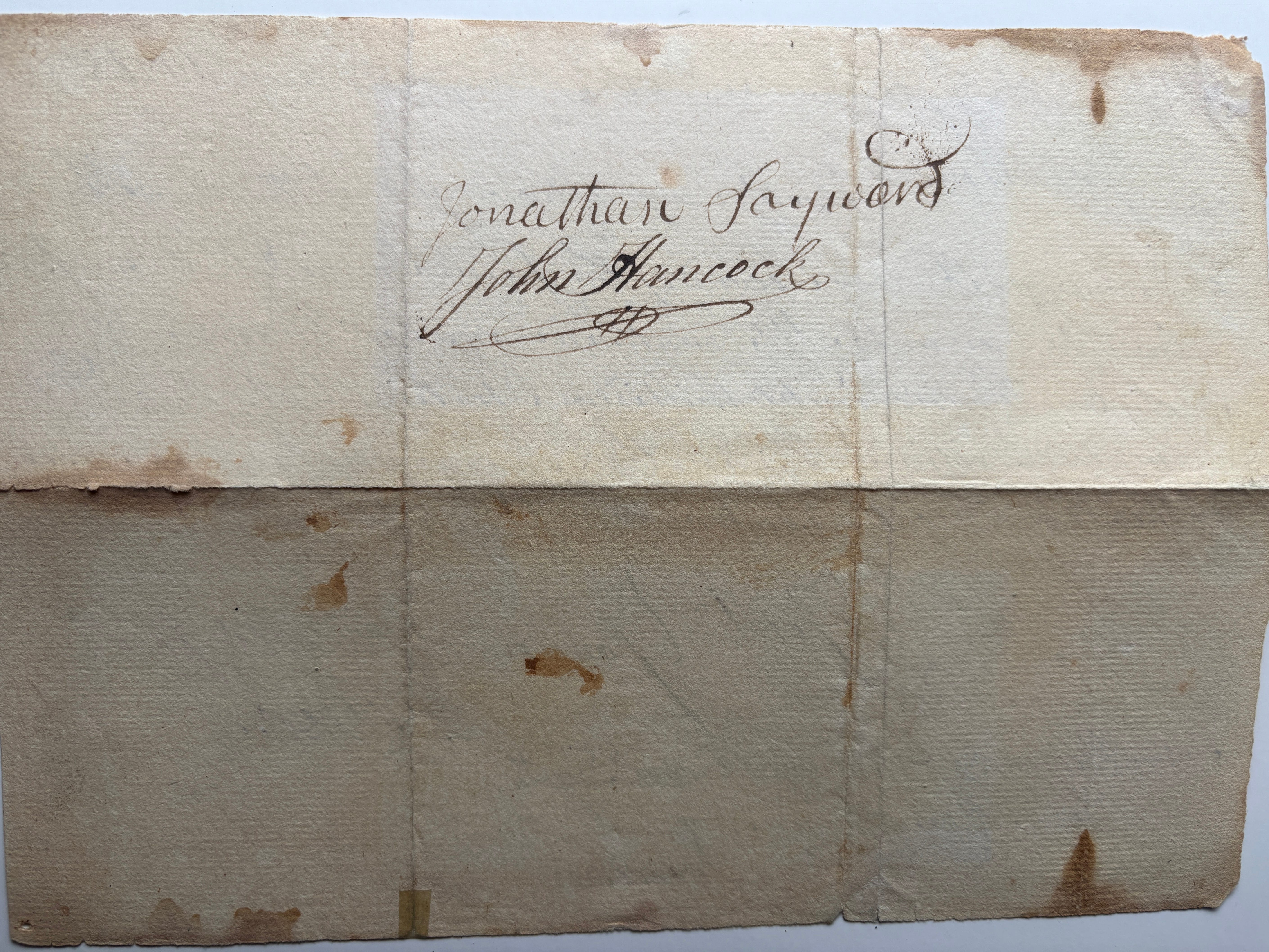
The verso of the unframed document: Jonathan Sayward above, John Hancock below. Both signatures authenticated by James Spence Authentication, Certification ZZ92876, March 2, 2026.
Within three years, Hancock would be organizing boycotts of the trade this system represented. Within ten, he would sign a document that made the political break with the empire permanent. Sayward would be ruined for his refusal to follow. Freame’s firm would endure — would outlast all of them — transformed over the following century into an institution that exists today under a different name.
The document captures them at the last moment they shared the same world. One morning in August 1765, in Halifax, before any of it happened.
Next in the series — Post 3: “The Morning After the Mob” — the Sayward diary images that changed everything about this story.
Paul G. Molé is a retired database administrator and independent scholar from Stillwater, New Jersey.